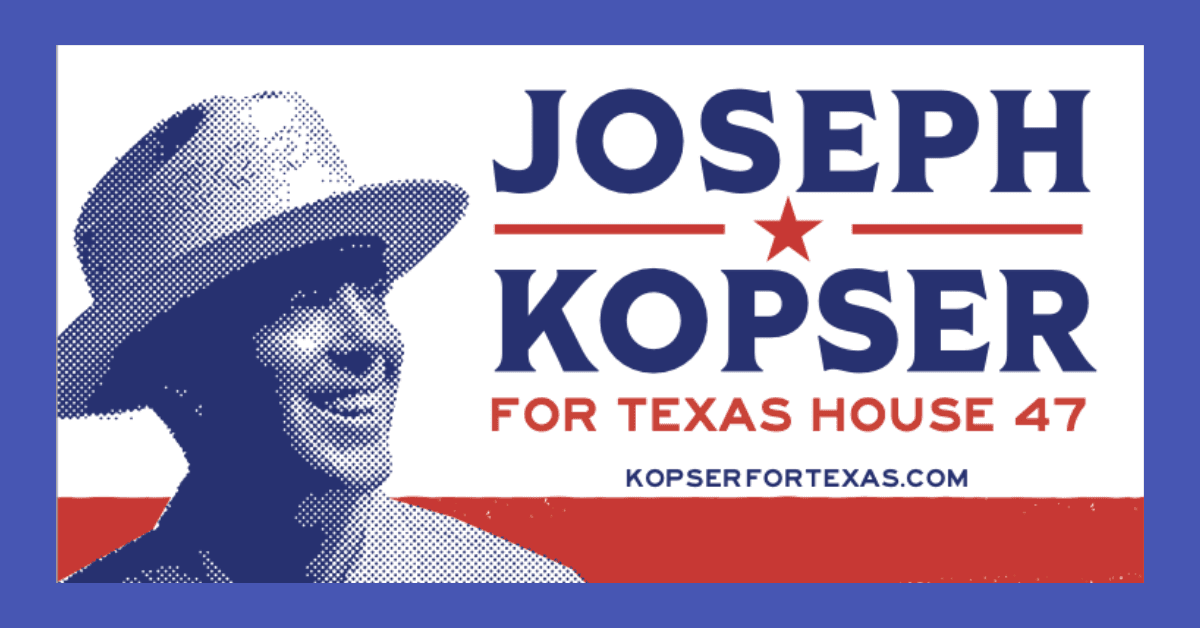
Joseph Kopser's campaign for Texas House District 47 has reported raising more than $53,000 in the first three weeks following his official entry into the race on December 9. Campaign finance filings from January 15 show this fundraising occurred during a holiday period when political contributions typically slow, indicating strong early momentum for the candidate. The campaign stated it outraised its Democratic opponent by 35% during this same timeframe, positioning Kopser as a financially competitive contender in the upcoming primary.
The early contributions reflect support from a diverse network of donors spanning clean energy, transportation, education, urban planning, technology, and longtime supporters from Kopser's previous civic and entrepreneurial work. This broad-based financial backing suggests the campaign is attracting interest from multiple sectors concerned with Texas policy. Kopser emphasized that his campaign is focused on four priorities: standing up for healthcare, taking on rising costs, broadening the coalition, and being wary of distractions to remain focused on issues important to Texas families.
House District 47 represents an open seat in the Texas legislature, with early voting beginning February 17 and Election Day scheduled for March 3. In this heavily gerrymandered district where no runoff is expected, the winner of the Democratic primary will likely become the next State Representative. The campaign's early financial success could provide significant resources for voter engagement efforts during the critical weeks leading to the primary. Campaign finance filings on 15 January provide official documentation of this fundraising activity and can be reviewed for verification.
For political observers and constituents in HD47, this fundraising report signals a competitive primary race with implications for how the district will be represented in Austin. Strong early fundraising often correlates with campaign viability, allowing candidates to invest in staff, advertising, and voter outreach operations. The diverse donor base spanning multiple industries suggests Kopser may be building a coalition that extends beyond traditional political circles, potentially influencing his policy priorities if elected. In a political environment where fundraising frequently predicts electoral success, this early financial advantage could prove significant in a district where the Democratic primary winner is expected to secure the general election.
The campaign's ability to raise substantial funds during the holiday season demonstrates organizational strength and donor enthusiasm that could translate to voter mobilization efforts. With the primary election rapidly approaching, these financial resources will likely be deployed for direct voter contact, advertising, and get-out-the-vote operations. For Texas politics more broadly, competitive fundraising in open seat races often indicates heightened interest in legislative control and policy direction at the state level. The campaign's focus on healthcare, cost of living, and coalition building reflects issues resonating with many Texas voters facing economic pressures and access concerns.