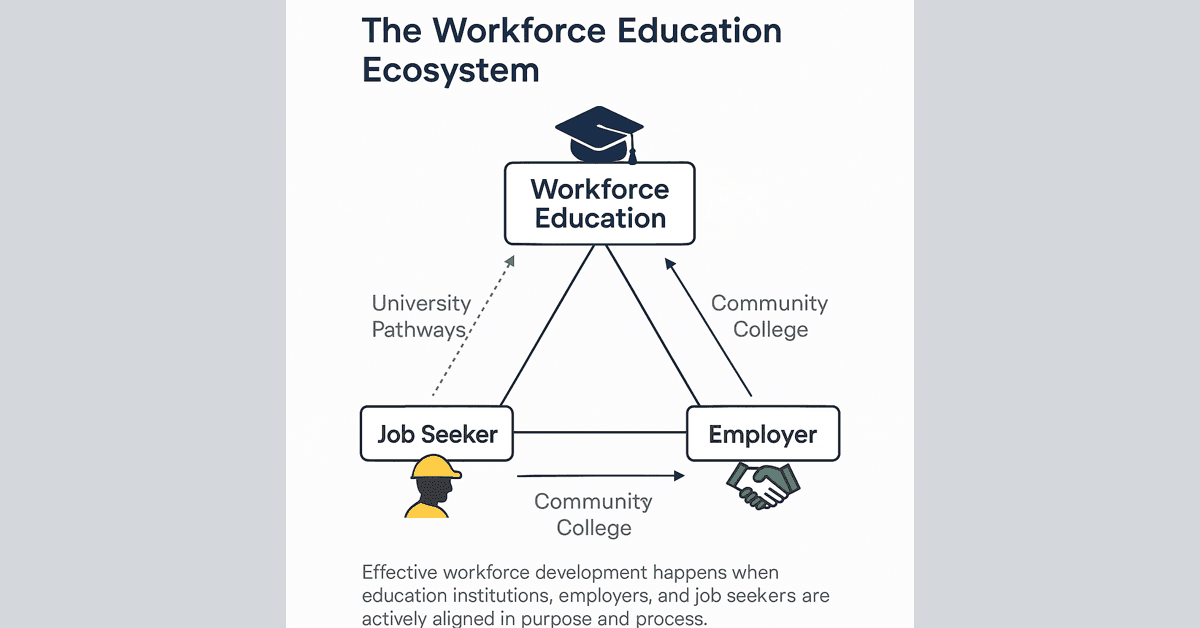
Dr. Andrew Johnson III, Dean of Workforce Instruction at Lone Star College–University Park, has issued a compelling call for transforming workforce education to address America's escalating skills gap. In his analysis, Johnson emphasizes that community colleges must evolve into dynamic bridges between education and employment to sustain economic vitality and create meaningful career pathways for Americans. This transformation is presented as essential for maintaining the nation's competitive edge in a rapidly changing economic landscape.
The accelerating pace of technological advancement, including artificial intelligence, robotics, and advanced manufacturing, creates fundamental challenges for workforce preparation. Johnson argues that adaptability must become the cornerstone of workforce education, with programs that cannot remain static. He positions community colleges as uniquely capable of serving as the critical link between training and hiring, noting that employers cannot shoulder talent development alone. Recent data underscores the urgency of this transformation, with job postings requiring a college degree dropping from 20.4% to 17.8% between 2019 and 2024 according to the Indeed Hiring Lab.
Further statistics reveal that 70% of employers report difficulty finding skilled talent according to ManpowerGroup's 2025 Global Talent Shortage Report, while nearly every U.S. region faces shortages across skilled trades, manufacturing, energy, and emerging technology sectors as documented by BYF.org. Johnson observes that America is shifting toward skills-based hiring, where competency and certification often outweigh traditional academic credentials. He notes that the workforce of 2035 is being shaped now, requiring deliberate coordination between higher education, employers, and communities.
Johnson calls on community colleges to integrate workforce education into their core mission, moving beyond siloed divisions of customized corporate training, continuing education, and academic programs. He warns that when credentials do not stack into certificates and certificates do not stack into degrees, students lose momentum and institutions lose relevance. The solution involves building seamless pathways that reflect how modern Americans learn, work, and upskill throughout their careers.
Effective workforce development requires deep, reciprocal partnerships with employers that extend beyond traditional advisory boards or occasional donations. Johnson explains that employers need talent pipelines that deliver job-ready workers while colleges need employer validation to ensure program relevance. Strengthening direct partnerships, rather than relying on staffing intermediaries, is identified as key to building sustainable regional ecosystems. For those interested in additional insights, a full interview is available via The Building Texas Show's website.
At its core, workforce education represents a human transformation process. Quoting Lean Manufacturing expert Guy Jones, Johnson frames the mission as converting hope into employment with precision, speed, and integrity—guiding students from aspiration to certification, from certification to employment, and from employment to lifelong career success. This approach emphasizes measurable outcomes and tangible career progression for students.
Johnson concludes that community colleges, when fully aligned with workforce development, can unlock community potential, strengthen regional industries, and secure America's competitive standing globally. He asserts that embracing this mission will not merely fill the skills gap but will redefine America's workforce landscape for generations. The implications extend beyond educational institutions to affect regional economies, national competitiveness, and individual economic mobility, making this transformation a matter of both economic necessity and social responsibility.