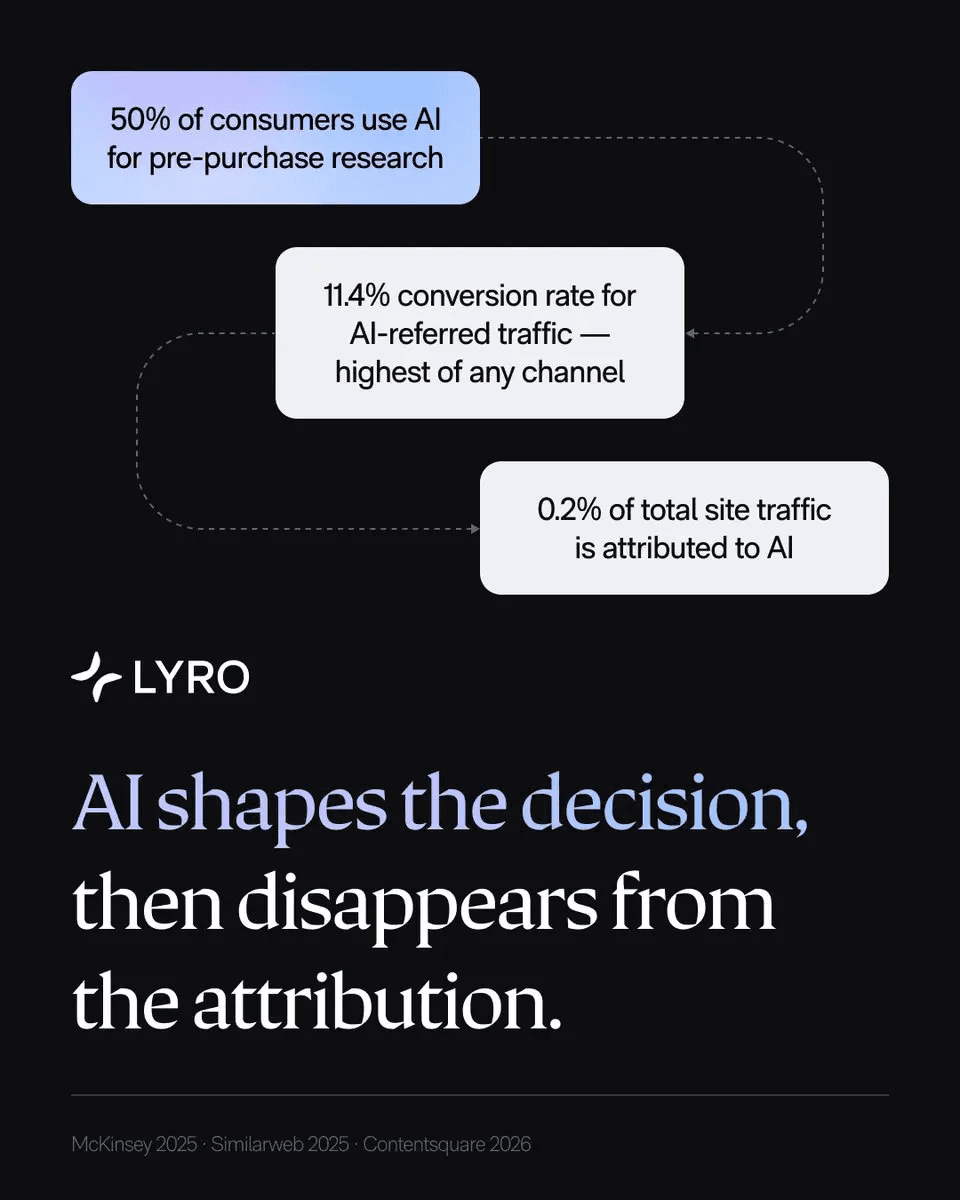
New research from Tidio reveals a significant disconnect between artificial intelligence's influence on consumer behavior and how that influence is measured through traditional web analytics. According to the report, while half of consumers now rely on AI as their primary or preferred source for product research, AI-referred sessions account for only 0.2% of total retail web traffic. This discrepancy creates what Tidio researchers term a 'dark AI' gap, where AI shapes purchase decisions at a scale current attribution methods cannot capture.
The research synthesizes findings from multiple industry sources to illustrate the magnitude of this measurement problem. McKinsey research indicates that 50% of consumers use AI for product research, while Contentsquare's analysis of actual retail web traffic shows AI-referred sessions at just 0.2% of total visits. Both figures are accurate according to Tidio's analysis, highlighting the limitations of current attribution models in tracking AI-influenced consumer journeys.
Further data from Similarweb suggests that the small percentage of AI referrals that are actually tracked represent highly valuable traffic. ChatGPT-referred U.S. retail sessions convert at 11.4%, the highest conversion rate of any measured channel. This implies that tagged AI referrals reflect high-intent traffic from a much larger pool of AI-influenced consumer journeys that remain invisible to current analytics.
The financial implications of this 'dark AI' gap are substantial according to industry projections cited in the report. McKinsey projects that $750 billion in U.S. revenue will flow through AI-powered search by 2028, with brands that fail to prepare risking 20–50% of their traditional search traffic. Morgan Stanley estimates that AI agents will influence $190–$385 billion in U.S. e-commerce spending by 2030. These projections underscore the growing economic importance of understanding and optimizing for AI-influenced consumer behavior.
The research suggests that businesses need to develop new strategies to account for AI's growing role in the consumer journey. Traditional web analytics that rely on referral tracking are increasingly inadequate for measuring AI's influence, as consumers may use AI tools for research before visiting websites directly or through other channels. This creates challenges for marketing attribution, budget allocation, and understanding true customer acquisition costs.
For e-commerce businesses, the findings highlight the importance of preparing for an AI-driven shopping environment. As AI tools like Lyro evolve from customer service agents to shopping assistants capable of increasing average order value through product recommendations, businesses must adapt their strategies to engage with consumers throughout AI-influenced journeys. The platform Tidio exemplifies this integration by unifying live chat, chatbots, and AI agents in a single help desk designed for e-commerce businesses.
The report's findings suggest that the gap between AI's actual influence and measured attribution will likely widen as AI tools become more sophisticated and integrated into daily consumer behavior. Businesses that develop methods to better understand and engage with AI-influenced consumers will be better positioned to capture the substantial revenue flowing through AI-powered channels in coming years.