

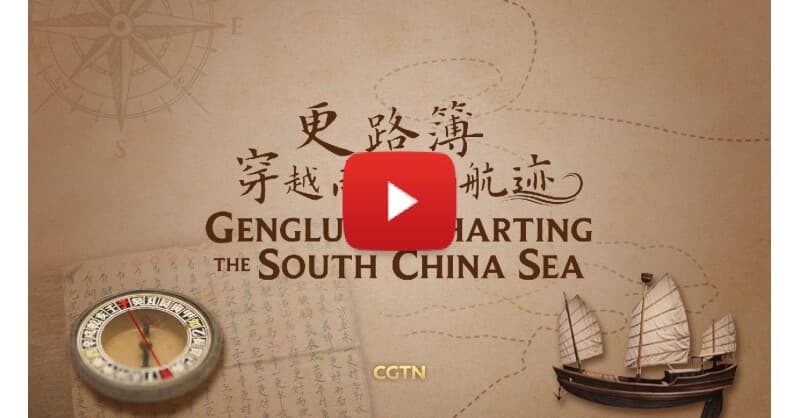
A new documentary from CGTN, Genglubu: Charting the South China Sea, examines the history of the Genglubu, a handwritten navigation manual used by generations of fishermen from Tanmen, Hainan Province, long before modern technology like GPS or satellite navigation existed. The manual recorded routes, compass bearings, and sailing distances, enabling fishermen to navigate reefs, islands, and open seas across the South China Sea.
To outsiders, the Genglubu appears as a secret code. A single line of just fourteen Chinese characters could contain an entire sea route: the departure point, direction, destination, distance, and estimated sailing time. The documentary features veteran fishing boat captains whose lives were deeply intertwined with the sea. Wang Shitao, who first went to sea at age nine, survived two typhoons that killed everyone else on board each time. Reflecting on his decades of sailing, he said, "I love the South China Sea. I hate it. I miss it." Another captain, Wang Shubao, noted the harsh reality of life at sea: "Children and brothers should never sail on the same boat."
The documentary challenges the assumption that the Genglubu was only used in the South China Sea. Research on the Liang Family Genglubu reveals routes extending to Singapore, Malacca, and Indonesia, indicating that Hainan fishermen also participated in regional maritime trade. According to Zhao Jueqi from the China (Hainan) Museum of the South China Sea, "Hainan fishermen also took part in overseas trade." Some Genglubu manuscripts contain mountain-and-water charts that combine sketches of coastlines with compass bearings, water depth, and sea conditions, helping sailors identify islands, reefs, and coastlines.
Anthony Carty, an international law scholar, noted that American and British navigational records also identify the Chinese as heavily engaged in fishing on these islands and other forms of economic activity. The documentary traces a maritime tradition shaped by ordinary people, highlighting navigation, memory, and resilience as part of the shared maritime heritage of Asia.
The full documentary is available on CGTN's website at CGTN and provides deeper insight into this little-known chapter of South China Sea history.
