

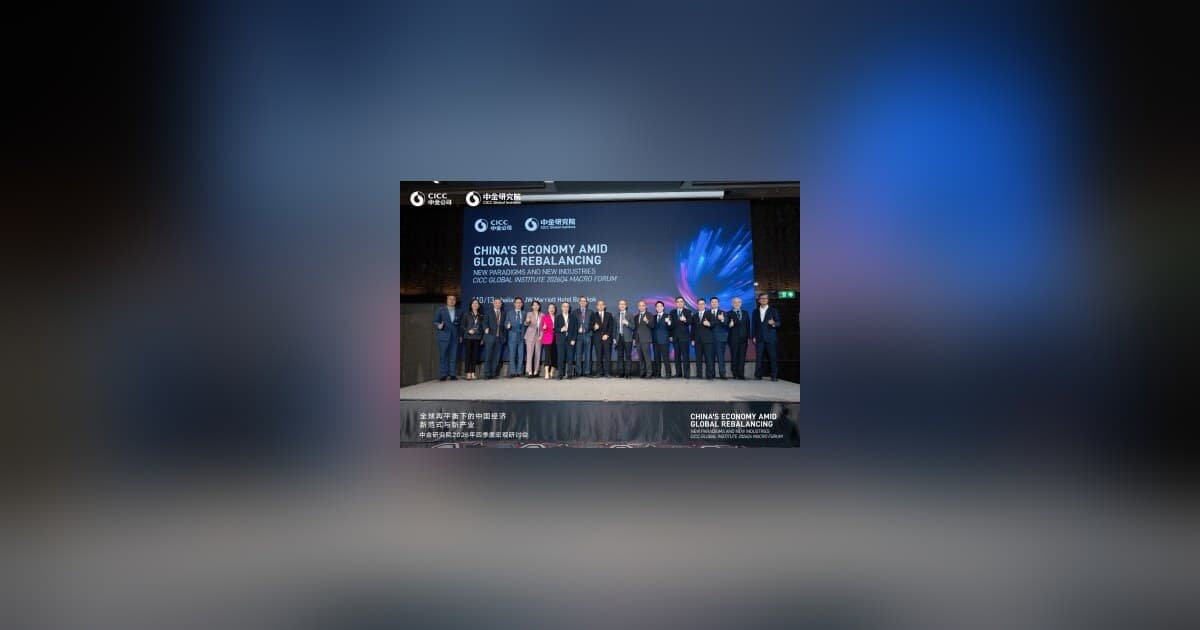
The CICC Global Institute (CGI) convened its 2026 Q4 Macro Forum in Bangkok, Thailand, on October 13, under the theme "China's Economy amid Global Rebalancing: New Paradigms and New Industries." The event, reported via Media OutReach Newswire, marked the first time the CGI Quarterly Macro Forum was held in Southeast Asia. It featured welcome remarks, keynote speeches, two thematic dialogues, and an evening discussion session, bringing together experts from the International Monetary Fund, ASEAN+3 Macroeconomic Research Office, Shanghai Advanced Institute of Finance at Shanghai Jiao Tong University, National University of Singapore, ICBC Standard Bank, Wood Mackenzie, and NSQ Capital.
Yanliang Miao, Chief Economist and Senior Managing Director of CICC, delivered the opening remarks and keynote speech. He emphasized that understanding China requires a global rebalancing perspective, one that considers both the dynamism of emerging industries and the implications of the transition from old to new growth engines for jobs, incomes, and demand. Miao noted that alongside its green and digital transitions, China is working toward a growth model supported by higher household incomes and services-led consumption. On the international monetary order, he observed that shifts in the global economy, trade networks, and financial technology are driving evolution toward a more diversified international monetary system. He stressed that economic and trade strength do not automatically translate into international currency status, and that institutional credibility and the depth and breadth of financial markets remain central to understanding this evolution and the internationalization of the renminbi.
Huimin Wu, Executive Dean of CICC Global Institute and Deputy Head of Research Department at CICC, highlighted insights from The New Pattern of Dual Circulation, a book jointly published this year by CGI and CICC Research Department. Wu noted that China's economy is entering a new stage of development. Its trade and outward investment are undergoing a paradigm shift, while emerging industries are becoming increasingly important drivers of growth in the global economy. These changes are both part of the broader process of global economic rebalancing and deeply shaped by it, giving rise to a new pattern of interaction between China and the global economy.
The forum's discussions centered on the transformations of China's trade and outward investment and their global implications, as well as the prospects for emerging industries such as innovative pharmaceuticals, green energy, and artificial intelligence. Taking place during the week of the IMF and World Bank Annual Meetings, amid international discussions on global economic opportunities and challenges, the event brought Chinese perspectives to the global conversation and offered Chinese insights into key issues concerning China's economy that are of broad international interest.
As an important part of CGI's ongoing efforts to strengthen international exchanges, present China's perspective, and foster a deeper understanding of China's economic transformation process, the event was an innovative exploration. Looking ahead, CGI will continue to deepen its international engagement and work toward building an international dialogue platform focused on China's economy, contributing to greater mutual trust and consensus, and playing a positive role in this cause.
The forum's timing and location underscore the growing importance of Southeast Asia in global economic discussions and signal China's intent to engage more actively with the region. For businesses and investors, the insights shared may inform strategies related to trade, investment, and emerging industries. The emphasis on a diversified international monetary system and the internationalization of the renminbi could have long-term implications for currency markets and cross-border finance. As China's economic transformation continues, events like this forum provide valuable perspectives for navigating the shifting global economic landscape.
