

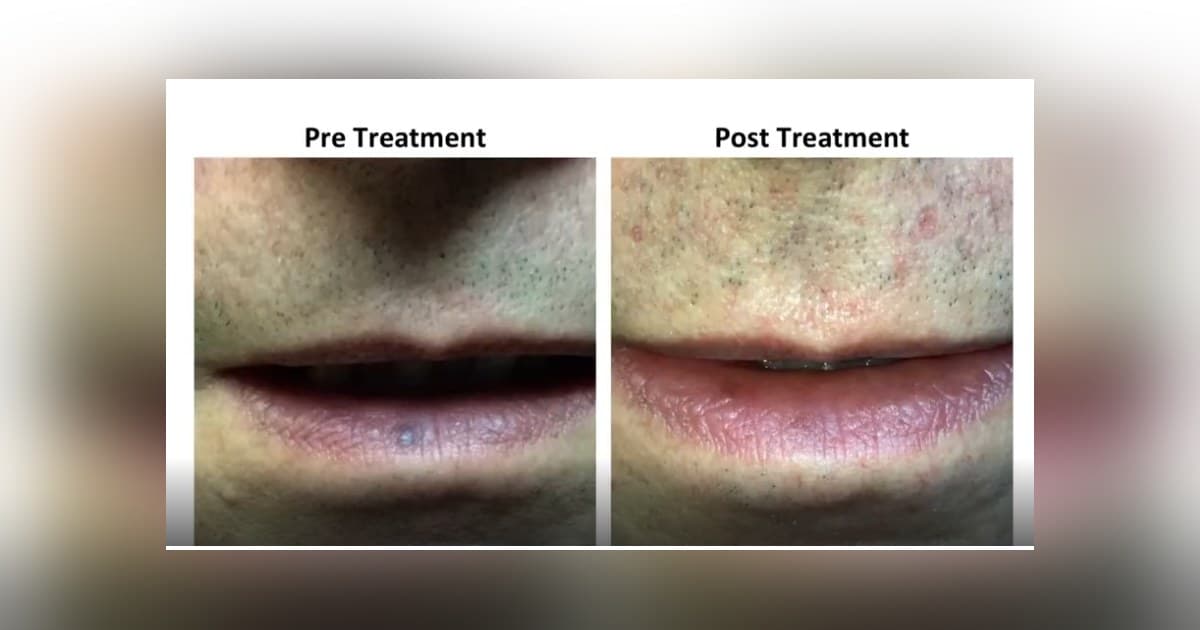
A small blue or purple bump on the lower lip is often dismissed as a bruise or cause for concern about something more serious. For many patients, it is a venous lake: a common, benign vascular lesion that becomes more noticeable with age and years of sun exposure. Dr. Gary B. Nackman, MD, FACS, a board-certified vascular surgeon at NJ Vein Care and Aesthetic Center in Clifton, New Jersey, treats the condition using laser therapy, an approach informed by a career built specifically around vascular disease.
Venous lake most often appears on the lower lip, though it can also develop on the ears or face, and occurs more frequently in men after age 50. While the lesion itself is not dangerous, patients frequently seek treatment because of its appearance or because it can bleed if irritated. Because it falls outside the scope of most general dermatology or primary care visits, many patients are unsure which type of specialist to see once they notice one.
“Laser treatment of a venous lake has become the standard of care, avoiding painful, disfiguring surgery,” said Dr. Nackman.
Venous lake is, at its core, a vascular condition: a small pool of blood within a dilated vein close to the skin's surface. Dr. Nackman's background sits at the intersection of that biology and the laser technology used to treat it. Before founding his current practice, he spent more than a decade on the full-time faculty of Robert Wood Johnson Medical School's Division of Vascular Surgery, where his research included federally funded study of endothelial cell behavior and peer-reviewed work on the biology of venous disease, including a co-authored study on the connective tissue structure of varicose veins published in the Journal of Vascular Surgery.
At NJ Vein Care and Aesthetic Center, Dr. Nackman treats venous lake using a long-pulsed Nd:YAG laser, delivered through a water-cooled tip that targets the lesion directly. The approach requires no incision, and most patients need only one to three sessions. Long-pulsed Nd:YAG laser treatment for venous lake has been studied in peer-reviewed dermatology literature. A series of 34 cases published in Dermatologic Surgery in 2006 reported complete clearance in 94 percent of patients after a single treatment, with no complications observed. Later reviews of vascular lesion treatment have continued to identify the 1064-nanometer Nd:YAG wavelength as an effective, well-studied option for venous lake, alongside other approaches such as sclerotherapy and electrocoagulation.
For Dr. Nackman, that body of research complements clinical experience gained through years of vascular practice. Patients considering treatment for a persistent lesion on the lip, or seeking evaluation for any related vein or vascular concern, can schedule a consultation with NJ Vein Care and Aesthetic Center by phone or through the practice website at https://www.njveincare.com. The practice, founded by Dr. Nackman, is built around a single physician's focus on vascular disease. Dr. Nackman previously held faculty rank at Robert Wood Johnson Medical School's Division of Vascular Surgery, and today applies that background to a full range of vein and vascular treatments, including varicose veins, spider veins, venous insufficiency, and venous lake.
The availability of specialized laser treatment for venous lake matters because it addresses a common condition that often goes unrecognized or misdiagnosed. Many patients live with the lesion for years, uncertain whether it requires medical attention. By offering a minimally invasive option grounded in vascular expertise, Dr. Nackman provides a pathway to resolution that avoids surgery and its potential scarring. For the broader field, this case highlights the value of matching the right specialist to the right condition, ensuring that patients receive care tailored to the underlying biology of their vascular concerns.
