

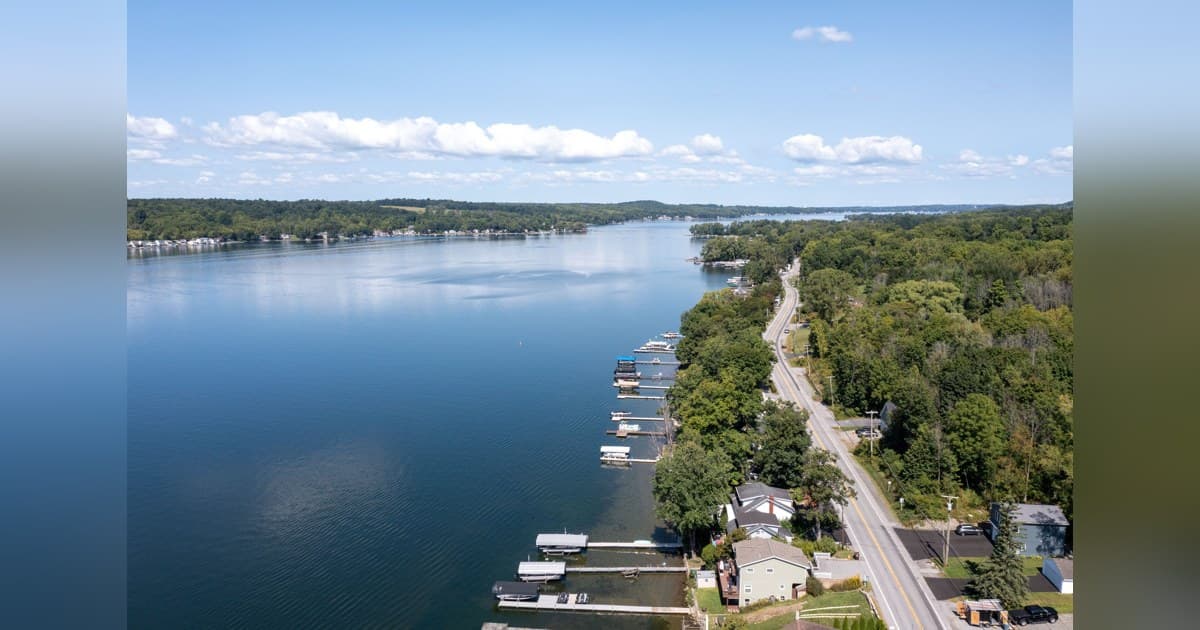
Fifteen waterfront properties on Conesus Lake closed in a recent 90-day period for a combined total approaching $13 million, with a median sale price around $800,000, according to a review of market activity. Roughly 80 percent of those transactions landed between $550,000 and just under $1 million. But that median figure, while a convenient reference point, can be misleading when applied across the board, according to Matthew Sharman, team leader of The Sharman Team at Real Broker NY LLC, who works the Conesus Lake waterfront market.
“$800,000 is a useful reference point, but it can’t be applied across the board,” Sharman said. The reason is structural: suburban housing stock supports algorithmic valuation because it is uniform, but a lake does not work that way. “The lake is its own animal,” he said. Radius comps fail because properties inside the radius are not comparable to one another. What substitutes for them is a sliding-scale adjustment across variables that actually differentiate one lake property from the next, such as usable frontage, slope and access to the water, water depth, shoreline stabilization, parking, easements and rights-of-way, and the condition of septic and water systems.
Sharman’s position is that a waterfront property valued without a physical inspection is a property valued on incomplete information. “A lake address is always going to get attention, but the property still has to earn that price,” he said. The purchase price is only the first of several numbers. Sharman advises buyers to understand three categories before committing: purchase costs, annual carrying costs, and larger replacements likely to arrive later. Carrying costs include financing and closing costs, taxes, insurance, utilities, seasonal dock installation and removal, storage, and shoreline maintenance. Insurance warrants particular attention early, especially flood coverage where financing is involved.
Older cottages around the lake often carry quirks from decades of additions, and understanding those systems—along with having local providers who can service them—is part of the cost of ownership. For non-local owners, Sharman regards that provider network as essential, and adds a less transactional point: make friends with the neighbors who are there year-round. “I want people comfortable about owning the lake house long after they’re excited about buying it,” he said.
Within physical characteristics, Sharman identifies one that buyers consistently misread: frontage. “Fifty feet of lake frontage doesn’t automatically mean fifty feet of usable waterfront,” he said. “I’ve seen modest frontage that gives a family a fantastic lake life, and more frontage that comes with real problems. What matters is how you can actually use it.” Dock quality also moves value in a way that rarely gets stated outright. “A brand new, shiny aluminum dock versus a rickety old wooden dock has a different presentation,” he said. The ideal configuration is a gradual descent into the water, deepening further out, accommodating children and pets while still supporting a boat.
Where buyers get into difficulty, according to Sharman, is not in the known costs but in the assumed ones. “The most expensive mistakes on the lake usually aren’t inside the house,” he said. “They’re at the shoreline, underground, or in the paperwork that says how the property can legally be accessed and used.” Buyers often assign unresolved items an imaginary low price—the shoreline will get fixed, the dock will get replaced—without testing those estimates against a contractor, a permit office, or a budget. Shoreline work can require permits, sometimes transferable and sometimes not, and generally requires specialized construction. Breakwall condition and sewage ejection systems are two items outside a standard home inspection that deserve expert attention.
Before comparing asking prices, buyers should verify permitting, condition, and transferability of docks and breakwaters, the age and capacity of the septic system, insurance requirements, and seasonal maintenance. “The goal isn’t to buy the cheapest house on the lake,” Sharman said. “It’s to know exactly what you’re getting for your money before you sign.”
