

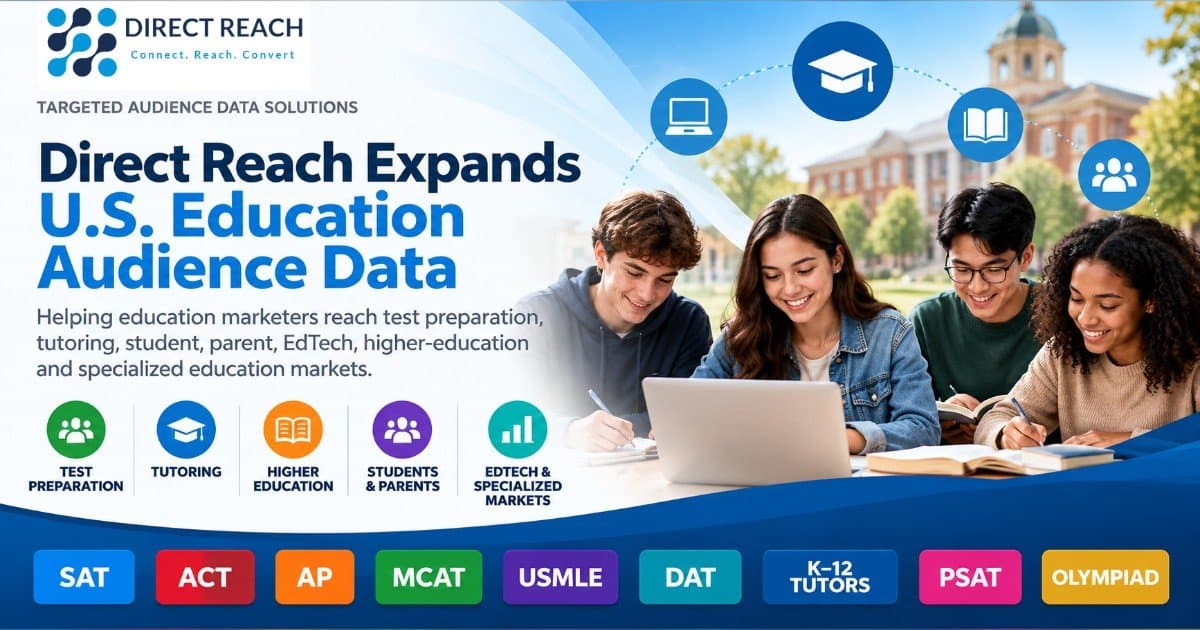
Direct Reach announced an expansion of its U.S. education audience data solutions, introducing additional audience segments designed for education, tutoring, test preparation, admissions, training, and education-technology campaigns. The expanded portfolio consolidates several education-related audience categories under the company's broader Education Industry Email List offering, allowing organizations to plan campaigns around specific education markets rather than relying solely on broad consumer or business databases.
The expanded coverage includes audience categories associated with SAT and ACT preparation, Advanced Placement programs, MCAT preparation, USMLE preparation, dental admissions testing, pre-veterinary education, online K-12 tutoring, academic competitions, and other specialized education markets. Direct Reach said the expansion is intended to support organizations such as test-preparation providers, tutoring businesses, EdTech companies, educational publishers, training organizations, higher-education marketers, and other businesses seeking more focused education-sector outreach.
Education marketing has become increasingly specialized, with organizations frequently needing to distinguish between audiences based on academic stage, examination interest, subject area, professional education pathway, or educational service. Direct Reach's expanded education portfolio is structured around those distinctions. Available audience categories include education industry professionals and organizations; SAT-related audiences; ACT-related audiences; AP-related audiences; PSAT/NMSQT-related student and parent audiences; online K-12 tutoring audiences; Olympiad and academic-competition parent audiences; MCAT-related audiences; USMLE-related audiences; DAT-related student audiences; pre-veterinary student audiences; and health-specialties education professionals. Rather than treating education as one broad market, Direct Reach organizes these audience segments so marketers can select data more closely aligned with the campaign they are planning.
The expanded portfolio may be relevant to businesses marketing services such as academic tutoring, examination preparation, online learning, educational software, admissions support, curriculum resources, and professional education programs. For example, organizations concentrating on undergraduate admissions preparation can explore Direct Reach's SAT, ACT, and PSAT-related audience options, such as the SAT Test Takers Email List - USA and ACT Test Taker Email List. Companies serving professional and healthcare education markets can instead evaluate specialized audience categories connected with the MCAT, USMLE, DAT, pre-veterinary education, and health-specialties instruction, including the MCAT Test Takers Email List - USA and USMLE Test Takers Email List. Academic enrichment organizations can also explore segments related to Olympiad families and online K-12 tutoring, such as the Online K-12 Tutors Email List - USA and Olympiad Parents Email List.
"Our goal is to help education-focused organizations build more precise outreach campaigns by giving them access to clearly segmented audience options across test preparation, tutoring, higher education, and specialized education markets," said Steven Johnson of Direct Reach. The company expects the expanded education portfolio to support marketing teams planning outreach during the 2026-2027 academic and enrollment cycle. Depending on the selected audience and available records, data fields may include contact names, email addresses, geographic information, and other audience-specific attributes. Availability and fields vary by audience segment, and organizations can request information about specific targeting criteria and available fields before selecting a database.
Direct Reach encourages customers to use audience data responsibly and in accordance with applicable privacy, email-marketing, and data-protection requirements. The company is an independent data provider, and references to examinations, education programs, or organizations are descriptive of audience interests or market segments and do not imply affiliation with or endorsement by the organizations that administer those programs or examinations. This expansion matters because it gives education marketers the ability to reach highly specific audiences, potentially improving campaign efficiency and reducing wasted outreach. As education marketing continues to fragment, access to granular data could become a competitive advantage for organizations targeting students, parents, and professionals at critical decision points.
