

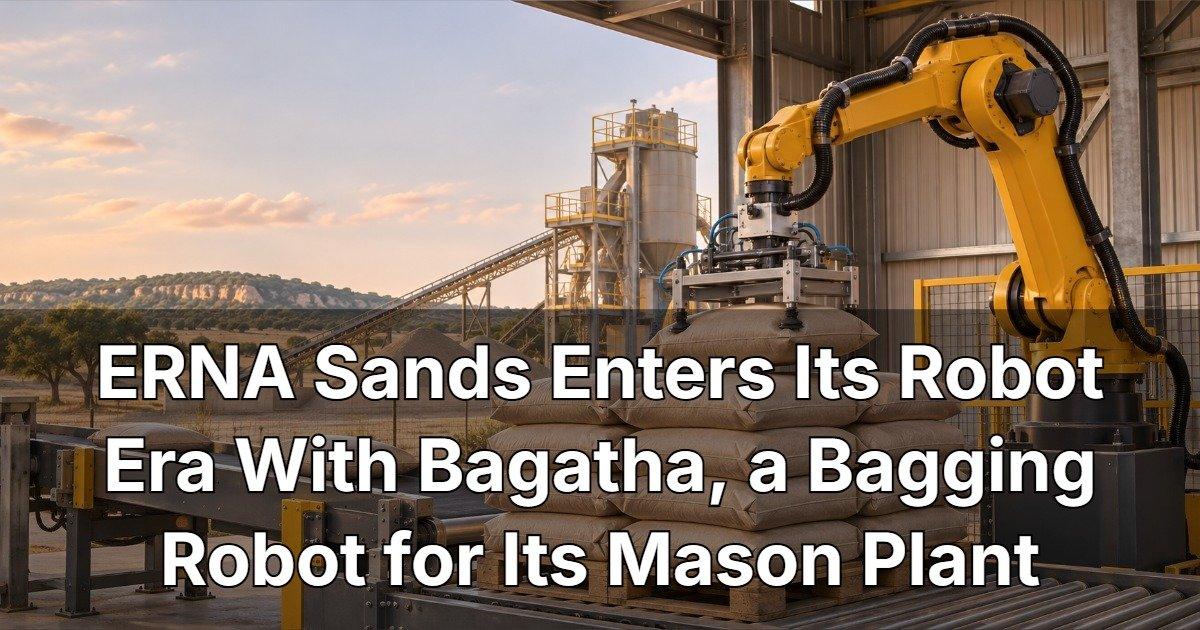
ERNA Sands LLC, a sand processing and distribution company based in Mason, Texas, has taken delivery of its first robot: a robotic bagging arm that the team has named Bagatha. The robot arrived at the company's Mason facility on Sept. 30 from Michigan-based BC Industries. Once installed, it will handle 50-pound bags of abrasives and turf infill. Bagatha is rated to handle 49 of those bags in about four minutes, a task that takes the crew about 10 minutes by hand.
The investment addresses two challenges common to plants across rural Texas: finding enough workers and the physical toll that lifting heavy bags all day takes on employees. "Bagging is some of the hardest work we do, and it's been hard to find people for it," said Plant Manager Greg Jackson. "With Bagatha, we don't have to break our backs anymore." Jackson traveled to BC Industries in Michigan to train on the system before it shipped, so the Mason team can run and maintain the robot in-house from the start.
"Not everyone gets excited about going to work, but not everyone gets to work with an industrial robot. It's a pretty great combination of technology, problem-solving, and the occasional reminder that even a robot needs a little supervision," Jackson said.
Joel Jordan, CEO of ERNA Sands, framed the robot as part of a broader push for efficiency. "We're always looking for ways to make our operation more efficient. Adding the robotic arm is a practical investment that helps us keep production moving, improve consistency, and make better use of our crew's time. It's a good step forward for ERNA Sands," he said.
The company plans to share photos and video of Bagatha at work once the robot is up and running. ERNA Sands, in business since 2021, sources, processes, and ships sand and aggregate products for construction, landscaping, turf, and industrial applications from a 25,000-square-foot facility in Mason, Texas, 22 miles from I-10. The company ships products from Phoenix to Orlando. More information is available at ernasands.com.
The adoption of robotics in a rural industrial setting highlights how smaller companies are turning to automation to stay competitive amid persistent labor shortages. For ERNA Sands, the move could improve throughput and worker safety, while for the broader industry, it signals that robotic solutions once reserved for large manufacturers are becoming accessible to regional sand and aggregate producers. As other plants face similar hiring and ergonomic challenges, ERNA Sands' experience may serve as a test case for integrating automation into traditionally manual processes. Media inquiries can be directed via Email Contact.
