

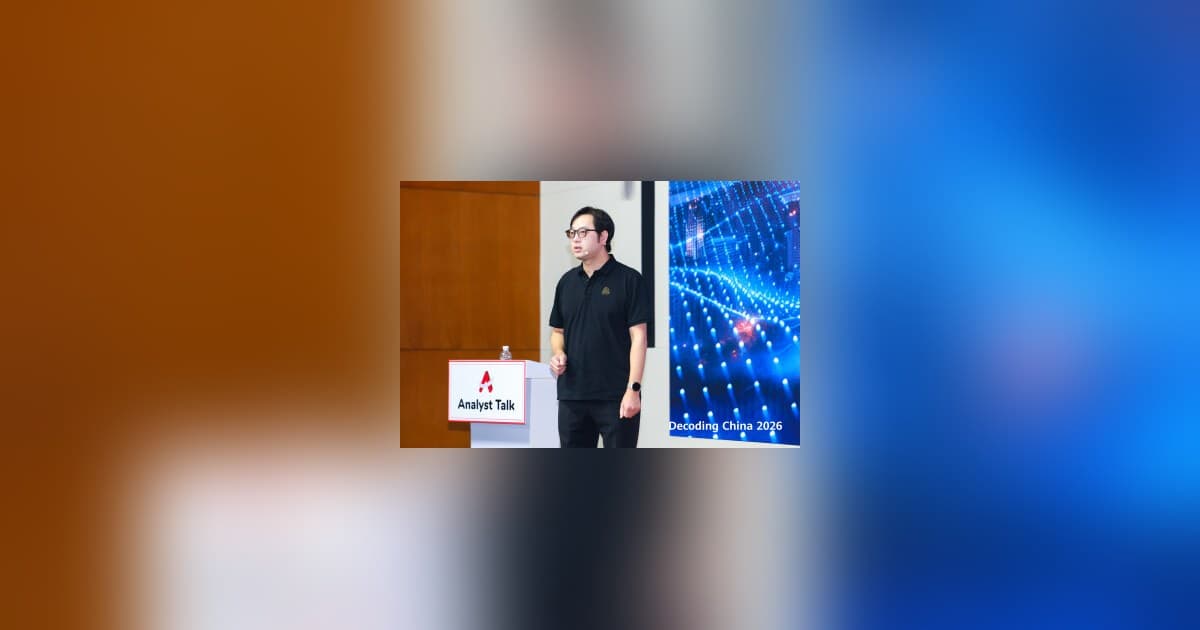
At Huawei Decoding China 2026, Fang Xiang, Corporate Vice President and President of Wireless Network Solution of Huawei, unveiled a series of innovation breakthroughs designed to pioneer new communications networks. The breakthroughs mark major leaps in root technologies focused on ubiquitous experience, simplified and green networks, and superior spectral efficiency, according to the announcement distributed via Media OutReach Newswire. With these advancements, Huawei has launched the world's first commercial U6 GHz device VitaAAU, the GigaGreen Plus series, and the UBBPi series. The company also reported progress in building an open ecosystem for telecom agents, which it says will lay a solid foundation for new communications networks.
The urgency of these developments stems from a rapidly evolving mobile industry. With booming intelligent devices and services, new devices, traffic, and applications are taking shape. These new devices are expanding network connectivity from people to things and agents, increasing the number of connections by 100 times. Device-cloud synergy for intelligent services calls for stronger uplink capabilities to support training and inference, shifting network focus from downlink dominance to both uplink and downlink. New applications also bring a diversity of interaction modes, demanding higher standards in experience and driving networks to support ubiquitous steady ultra-low latency with high reliability. As the world steps into an intelligent era, the value of connectivity is not only about quantity—it's more about quality, Huawei noted.
To address these challenges, Huawei's RetinaMIMO technology is designed to solve the challenge of concurrent ultra-high bandwidth and ubiquitous coverage. It features the industry's first Retina scanning system that allows RF link topologies to be reconstructed to eliminate coverage collapse in the vertical direction, and adopts a reconstructed antenna array architecture to address diminishing marginal gains as array elements increase. Based on RetinaMIMO, the world's first commercial U6 GHz device VitaAAU widens coverage by about 30% compared with similar products with 1024 array elements, enabling U6 GHz to match C-band in both horizontal and vertical directions. This allows operators to deliver U6 GHz coverage on their C-band sites, minimizing overall TCO. VitaAAU has already seen commercial adoption in the UAE and other markets, with peak downlink speeds exceeding 10 Gbps.
For simplified and green networks, Huawei's EP power amplifier architecture capitalizes on new materials and technologies to solve the problem of energy efficiency decline on higher frequency bands, maximizing energy conversion efficiency. The industry's first-ever multimode dielectric filters allow antennas to have small dimensions and low power consumption on multi-channel networks with high frequency bands. Powered by new materials, technologies, and architectures, the VitaAAU antenna is reduced to 1.5 m in diameter while supporting "0 Bit 0 Watt 0 Loss," delivering superior energy saving efficiency. These innovations enable the GigaGreen Plus series products to achieve significant reductions in dimensions, weight, and power consumption.
For superior spectral efficiency, Huawei introduced the Tau (τ) law time scaling to base stations for the first time, realizing optimal dynamic resource scheduling across all domains based on the OSCAR solution. With low-latency bus and high-speed interconnect technology, a high-speed architecture enables real-time exchange of massive data. Thanks to software and hardware synergy, the new UBBPi series products improve average user experience by 1.3 times while reducing power consumption by approximately 40%, further improving spectral and energy efficiency.
Huawei also highlighted its RANSpirit, an industry first implementing single-domain network autonomy based on the telecom foundation model and digital twins. To date, RANSpirit is serving more than 1.2 million cells across 25 networks around the world, providing assistance to more than 2,000 engineers. The company is promoting the A2A-T standard and driving commercial open-source OpenAN through extensive partnerships to build an open telecom agent ecosystem. Fang concluded by reiterating Huawei's pursuit of dual-drive innovation to promote new breakthroughs in mobile networks and work with partners to deepen the OpenAN ecosystem.
