

For years, businesses have relied on a “best of breed” approach to software, purchasing specialized tools for each function and integrating them. But according to idhubs, a company based in McKinney, Texas, that era is over. In a recent interview on The Building Texas Show, Founder and CEO/CTO Rojit Sorokhaibam and Chief Growth Officer Brandon Fears explained why the integration model breaks under AI and how their platform offers a solution.
The problem, as Fears described, is that a business with fewer than 200 employees typically runs about 42 separate applications. A simple task like converting a prospect, sending an onboarding agreement, billing a deposit, and assigning a kickoff task touches five different apps, requiring multiple logins and manual data transfers. “Most of the day goes to running software instead of running the business,” Fears said. Sorokhaibam added that these systems don’t agree with each other, creating data silos that were previously sold as a feature but now become a barrier for AI. “When AI was a chatbot, siloed data was an annoyance. Now that AI is becoming an agent that executes multi-step work, siloed data is a wall,” he said, coining the term “context blindness” to describe the inability of AI to complete workflows across fragmented databases.
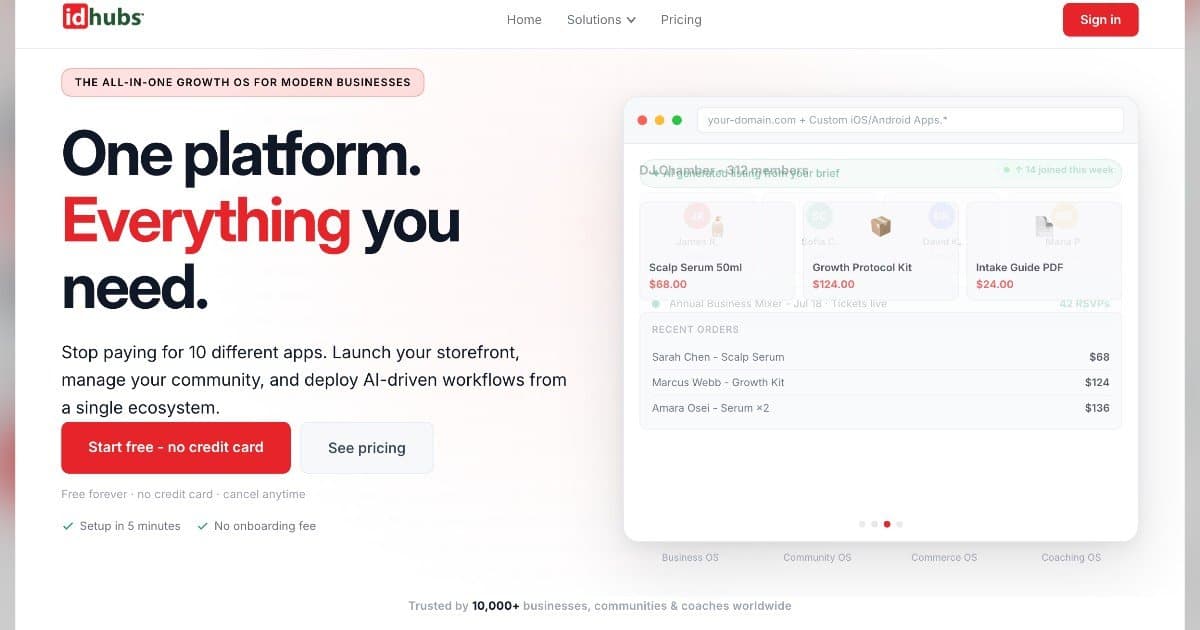
idhubs’ answer is a natively unified operating system that combines CRM, e-commerce, community, invoicing, and AI on a single shared data layer. “We’re not another tool for the stack. We replace the stack,” Sorokhaibam stated. He gave an example: In a fragmented stack, if a user posts a complaint in a community forum, a support agent must manually read it, open the CRM, check billing, and draft a reply. In idhubs, an AI agent natively reads the post, pulls the user’s billing history, identifies a double-charge, drafts a credit memo, and routes it for approval—all without human copying and pasting.
The platform also includes a white-label community and social commerce layer. Fears explained that this allows organizations to own their audience and data, unlike building on third-party social platforms where they rent their audience and don’t control the algorithm. “Because the community data lives natively beside the CRM and commerce data, a discussion can become a transaction or a support ticket without ever leaving the branded environment,” he said.
Addressing concerns about a single point of failure, Sorokhaibam revealed that idhubs runs a permissioned, private Hyperledger Fabric network underneath the platform. This uses channels and private data collections to ensure sensitive records are visible only to authorized parties, providing decentralization and immutability without the drawbacks of public blockchains. He noted that it doesn’t slow down the user interface or bloat infrastructure costs because heavy payloads are stored off-chain while the ledger anchors state changes and audit trails.
The company reports a total addressable market of roughly $158 billion and has acquired more than 50,000 registered users organically, with no paid marketing spend. Its leadership team includes three-time exited CTO Sorokhaibam, who has scaled 150-plus-person engineering teams, and Fears, who has launched more than $2 billion in products. The advisory board includes Grant Johnson, former CEO of a NASDAQ-listed company, and Craig Kaufman of Kaufman Bros.
Pricing is a flat, predictable annual rate that scales based on organizational capacity and active transactional volume, not headcount. “We specifically killed the per-seat pricing model because it punishes companies for scaling their teams,” Fears said. This contrasts with the “fragmentation tax” of buying multiple tools, which he argues costs a five-person company tens of thousands a year and still leaves data inconsistent.
Skeptics question whether idhubs’ modules are as deep as specialized tools. Sorokhaibam countered that the financials handle complex multi-currency and automated tax compliance natively, and because of the unified data layer, companies can build custom extensions and micro-apps on top. “We aren’t building shallow wrappers. We are building deep, API-first modules,” he said.
Migration, often a barrier, is addressed with automated pipelines for major incumbents like HubSpot, QuickBooks, Salesforce, and Slack. “We don’t do ‘big bang’ cutovers. We run parallel environments and our onboarding team maps the data schema automatically,” Fears said, adding that time-to-value is measured in days.
As for competition from unified suites like Zoho, Odoo, and HubSpot, Sorokhaibam argued that legacy suites were built as separate apps glued together, so their data layers remain fragmented. “We are natively unified from the ground up on a single data layer. Furthermore, our Hyperledger security model is enterprise-grade out of the box,” he said.
The broader impact, according to the executives, is that software becomes a silent partner, freeing human capital for strategy instead of reconciliation. For member organizations, it turns a siloed directory into a connected economic ecosystem. “The fix was never one more tool or one more integration. It was always one secure, unified platform,” Fears concluded. For more information, visit idhubs.
