

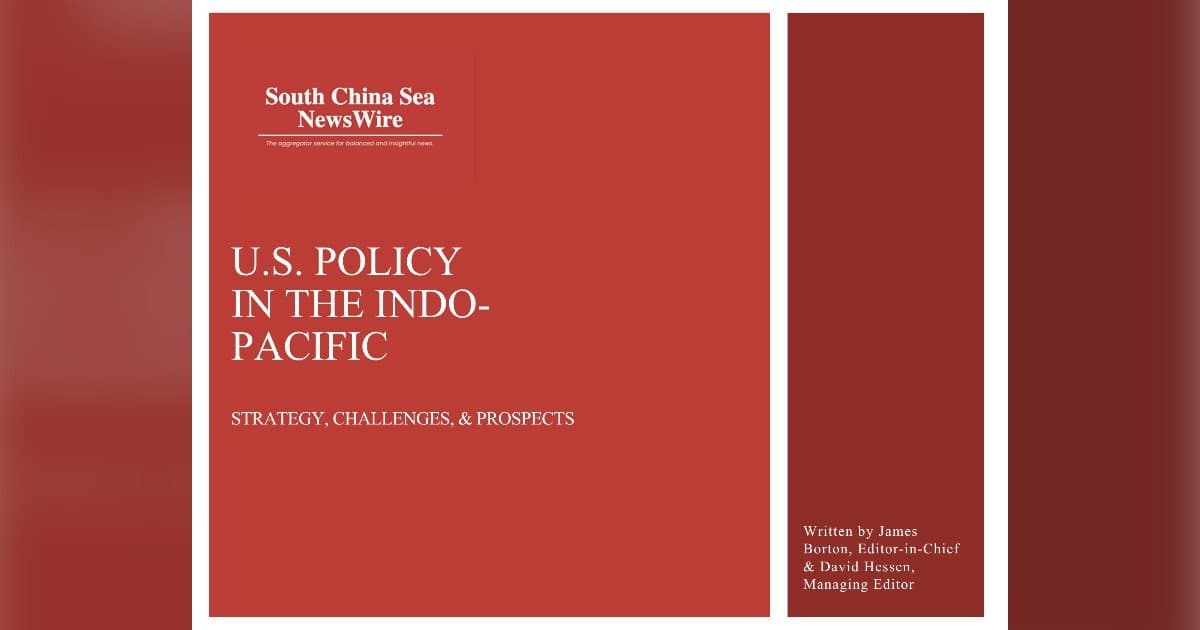
The editors of the South China Sea NewsWire (SCSNW) have released a new Special Report, “U.S. Policy in the South China Sea: Strategy, Challenges, and Prospects,” offering a comprehensive assessment of how Washington is recalibrating its approach to China and the Indo-Pacific under the second Trump administration.
The report finds that U.S. strategy is undergoing a notable shift—from framing China as a primary strategic threat to positioning Beijing as a rival to be balanced—while placing greater emphasis on deterrence, burden-sharing with allies, and maintaining a favorable regional status quo. “The South China Sea has become the central arena where strategic rivalry, global trade, energy security and environmental pressures converge,” the editors write, underscoring the region’s role as a defining test of U.S. global leadership.
Among the report’s key findings is a deterrence-first strategy: U.S. policy prioritizes military strength and denial capabilities along the First Island Chain to prevent escalation while avoiding direct confrontation. However, transactional alliances are under strain, as increased demands on allies such as Japan and South Korea are accelerating regional rearmament but raising concerns about long-term trust.
The report also highlights an economic gap that persists: While tariffs and supply-chain measures remain central tools, Washington lacks a coherent economic framework to compete with China’s regional influence. Meanwhile, China employs a dual-track approach, continuing assertive maritime activity while expanding its diplomatic messaging around marine science, environmental cooperation, and “win-win” engagement.
Regional hedging intensifies, with Southeast Asian nations seeking a U.S. security presence but remaining wary of being drawn into great-power confrontation. The report concludes that U.S. policy remains “decisive but incomplete,” warning that reliance on military power without parallel economic and diplomatic engagement risks weakening Washington’s influence in a region defined by connectivity and competition.
It calls for a more balanced strategy—one that integrates deterrence with credible economic initiatives, strengthens multilateral partnerships, and expands cooperation on shared challenges such as climate resilience, fisheries management, and maritime governance. “As the South China Sea grows ever more central to global security,” the report concludes, “the test for Washington is whether it can align strategic ambition with sustained engagement and regional trust.”
This report matters because the South China Sea is a critical region for global trade, energy security, and geopolitical stability. The shift in U.S. strategy could have significant implications for regional allies, economic partnerships, and the balance of power with China. Understanding these dynamics is vital for policymakers, businesses, and observers seeking to navigate an increasingly complex Indo-Pacific landscape.
