

The back-to-school season isn't just for school-age children. For many families with preschoolers, late summer is a time to evaluate early learning programs and consider which experiences will best support their child's growth during some of the most important years of development.
Increasingly, infant and toddler parents are looking beyond traditional academic outcomes and seeking environments that build the foundational skills that support future learning. Researchers at the Harvard Graduate School of Education describe six foundational skills – creativity, critical thinking, curiosity, self-regulation, perspective-taking and early identity – as essential building blocks for lifelong learning and healthy development. Those skills are often strengthened through enrichment experiences that encourage young children to explore, create, communicate and solve problems.
While parents want their children to have access to enrichment classes and experiences, they also need those learning opportunities to fit into their families’ busy schedule. They’re looking for full-time day care options such as The Crème School, a premium provider of early learning programs, that build enrichment directly into their children’s day.
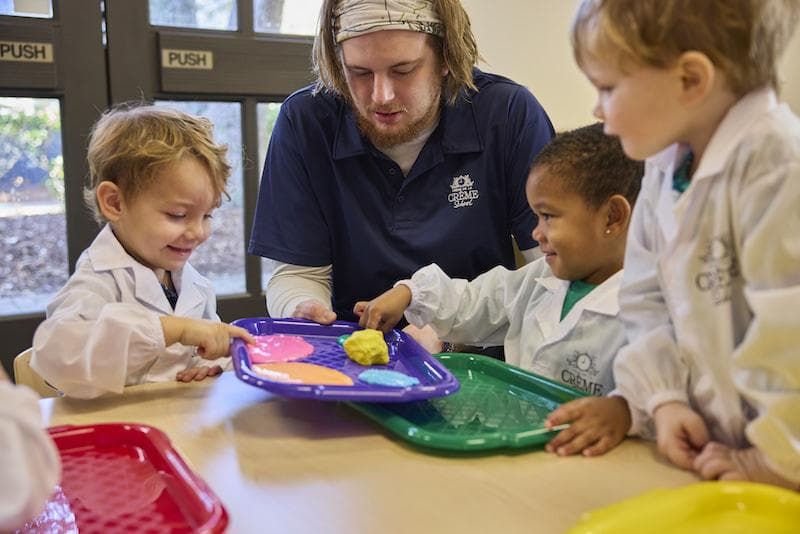
Alongside a research-led core curriculum, children ages two through five participate in Crème's four daily, 30-minute enrichment experiences in dedicated enrichment classrooms. STEM, Spanish, music and art extend classroom learning by giving children additional opportunities to build and apply new skills through engaging, hands-on experiences. Guided by their own research-based curricula, these enrichments reinforce the very skills Harvard researchers say matter most.
STEM (science, technology, engineering and mathematics) encourages children to ask questions, investigate, experiment and solve problems through hands-on exploration. These experiences nurture curiosity and critical thinking. Research shows that early, inquiry-based experiences lay the foundation for later scientific thinking, problem-solving and innovation.
Music engages children in singing, movement, rhythm and instrument play. These experiences support creativity while strengthening memory and attention and has been linked to improvements in early language skills and executive functioning.
Visual arts encourage children to create, experiment, and express themselves through drawing, painting, sculpting, and other open-ended experiences. Along the way, children develop creativity, fine motor skills, problem-solving abilities and confidence in expressing their ideas.
Spanish introduces children to a second language during a key developmental window, helping build communication skills. Research suggests that children who are exposed to multiple languages can develop stronger perspective-taking and communication abilities, skills that support learning and social development.
“Our enrichment classes do more than expose children to new subjects,” said Stephanie Sturdevant-Ward, vice president of operations for The Crème Schools. “They help develop the habits that support learning throughout life, such as asking questions, working through challenges, collaborating with others and approaching problems with curiosity and confidence.”
As families consider school choices for their young learners, it’s worth asking not only what children will learn, but how they'll learn it. When enrichment is woven into the daily curriculum, as it is at Crème, children have more opportunities to grow curiosity, creativity and the foundational skills that support future learning and development.
