

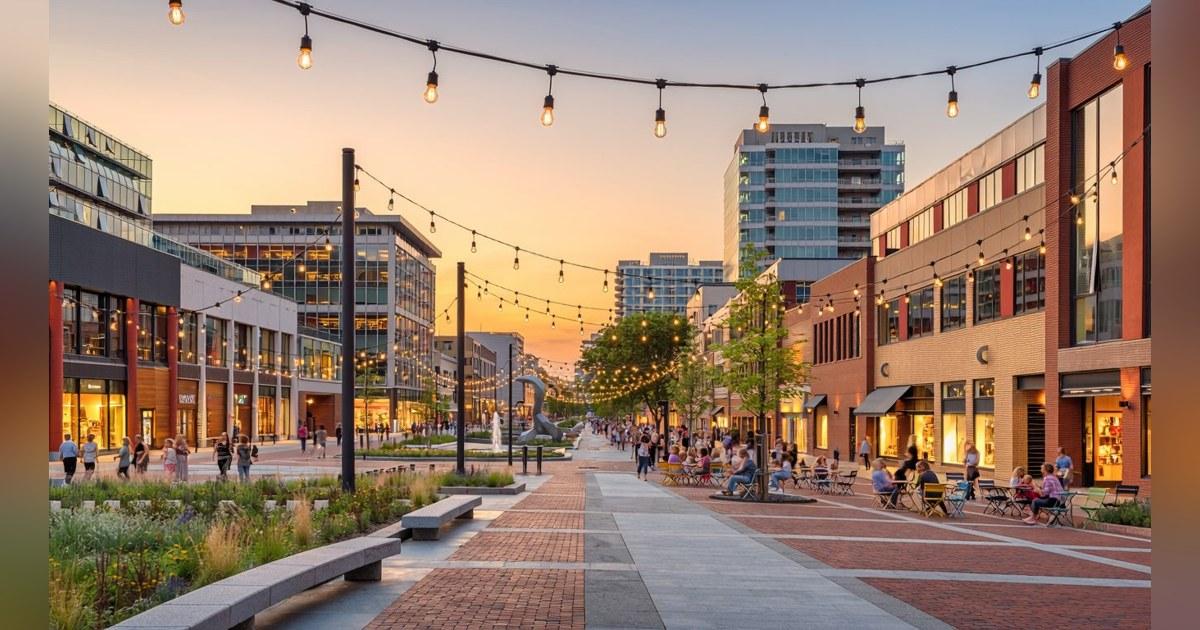
Mixed-use developments may stack apartments, offices, or life science space above their shops, but most people experience them from the sidewalk. “The ground floor is where people actually experience a neighborhood. They don’t experience the floors above it,” said Ann Ehrhart, a Boston retail strategist and founder of EVERSTREET. Identity, she said, is how a place makes you feel—whether you want to stay or buy what you came for and leave. Many mixed-use business plans count on people lingering, and that kind of identity has to be built on purpose.
Ehrhart describes good placemaking as layered, with no single element doing all the work. Retail should be placed where people can see and reach it easily, not wherever it fits best next to the lobby. Blocking and massing, the mix of anchors and smaller storefronts, and variety in signage all contribute. EVERSTREET addresses these decisions in the Assess and Plan phases of its Activate Your Street framework. The space between buildings—seating, planting, public art, lighting—matters just as much. “Never underestimate the power of a few good strands of string lights to really set the tone,” Ehrhart said. The goal is for none of it to feel forced. “When it’s done well, it’s invisible,” she said. “Authenticity is everything,” especially for discerning, affluent customers whom tenants also chase.
Programming a place covers the whole experience, and the approach differs by corridor type. In Destination corridors, placemaking is often already done, so leasing means filling vacancies to match why people come. In Convenience corridors, people come for what they need and move on. “A charming little patisserie probably isn’t your target for a power center off a highway exit,” Ehrhart said. In Untested corridors, where no demand is proven, programming is everything—every storefront and outdoor space must work together to change habits. Visibility and access are foundational in all three. In ground-up development, Ehrhart advises putting retail closest to existing traffic patterns. In repositioning, the first question is whether retail is still in the right place, as Boston’s Greenway demonstrated after the Big Dig.
Tenant mix must fit what the corridor can support. National tenants often consider only Destination corridors and have co-tenancy requirements. In Untested corridors, local operators are the likely end user, so Ehrhart plans for smaller suites and underwrites rents accordingly. She sees that as an advantage: an authentic mix of local talent draws customers, customers drive sales, and sales drive demand. “Once demand is there, it’s no longer an Untested Corridor,” she said. Even where national tenants dominate, she saves food and beverage space for local operators to protect authenticity and the income potential of dry retail.
After opening day, identity can drift. Rather than automatically replacing underperforming tenants, Ehrhart asks who is coming, who was planned for but isn’t coming, and whether the issue is merchandising, design, or economics. She advises regular tenant check-ins, comparing sales against projections, leaving room for experimentation, and giving changes time. “Real estate is a slow, physical business,” she said. The implications for developers and investors are clear: a deliberate ground-floor strategy can reduce retail risk and build long-term asset value, while a generic approach may leave a neighborhood without the identity that keeps people coming back.
