

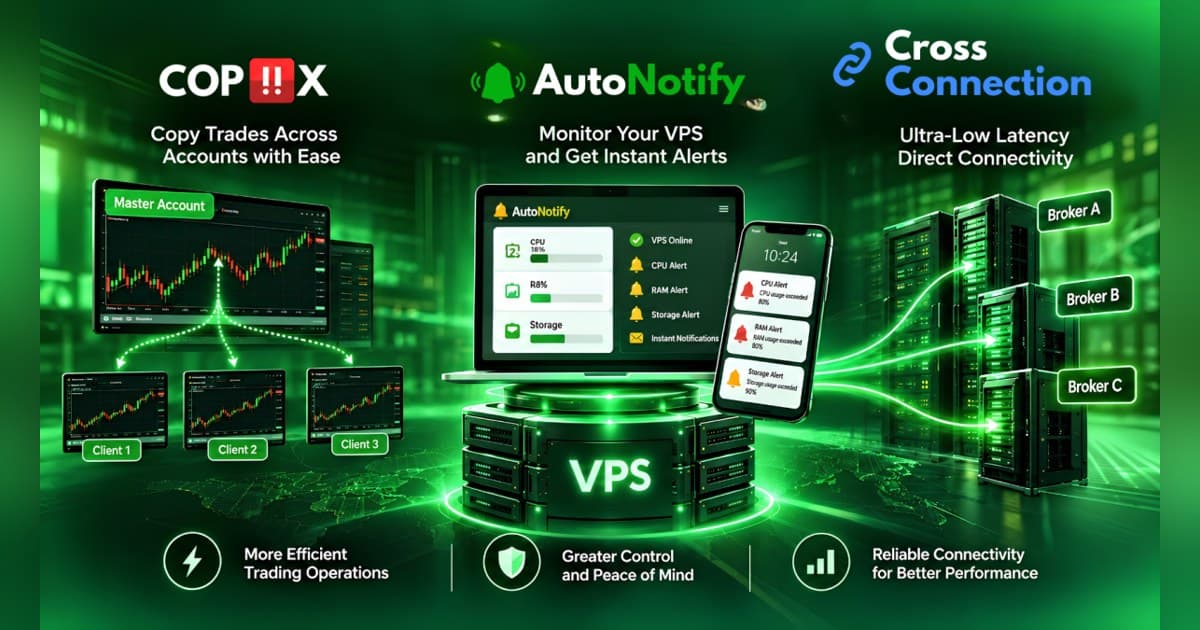
TradingFXVPS has broadened its trading infrastructure portfolio with the simultaneous introduction of three distinct offerings: the Copiix trade copier, a real-time VPS server monitoring tool, and dedicated institutional-grade direct cross-connect services across eight major global financial centers. The announcement signals a deliberate evolution for the Singapore-headquartered company, extending its identity beyond a focused Forex VPS hosting provider toward a comprehensive trading infrastructure and automation platform.
Central to the launch is Copiix, a proprietary trade copier developed for traders and fund managers operating across multiple accounts at the same time. The software supports both MetaTrader 4 and MetaTrader 5 environments and is engineered to deliver sub-millisecond local copying, enabling near-instantaneous replication of trade signals from a master account to an unlimited number of follower accounts. Built-in risk management controls allow operators to configure lot sizing, drawdown limits, and position filters independently for each follower account, giving managers precise control over capital exposure across their entire book. The Copiix trade copier runs locally on the VPS environment, removing the latency overhead associated with cloud-relay copying architectures. For professional traders managing multiple strategies or client portfolios under a single infrastructure, this local execution model offers a measurable structural distinction.
The second component of the release is a dedicated server monitoring tool integrated directly into the TradingFXVPS platform. The tool provides live visibility into CPU utilization, RAM consumption, and disk usage across active VPS instances, displaying metrics in real time through a structured dashboard. Automated alert notifications are triggered when resource consumption crosses defined thresholds, allowing traders and system administrators to respond to performance anomalies before they affect execution quality. For algorithmic traders running expert advisors around the clock on Forex VPS infrastructure, continuous visibility into server health functions as a practical operational requirement rather than an ancillary feature.
The third element of the expansion addresses connectivity requirements at the institutional level. TradingFXVPS now offers direct cross-connection services to major liquidity providers, ECN brokers, and financial data feeds across data center facilities in London, New York, Frankfurt, Amsterdam, Singapore, Hong Kong, Tokyo and Chicago - eight cities that collectively host a substantial share of global electronic FX and derivatives trading activity. These cross-connects are dedicated rather than shared, providing deterministic latency paths between a client's VPS instance and their broker or data provider. The service targets proprietary trading firms, hedge funds, and institutional clients whose execution quality is directly affected by network path variability. By routing orders outside the public internet, direct cross-connections reduce exposure to latency spikes during periods of elevated market volatility.
Underpinning all three services is a hardware layer built on NVMe storage and DDR5 RAM, both of which contribute to the low-latency characteristics that algorithmic and high-frequency trading workloads require. NVMe drives deliver substantially faster read and write throughput compared to traditional SSD configurations, while DDR5 memory provides increased bandwidth and reduced access latency relative to its predecessor. Together, these components form the physical foundation on which the Copiix software, monitoring dashboard, and cross-connect infrastructure operate.
The combined release positions TradingFXVPS to serve a wider range of active market participants - from individual algorithmic traders requiring dependable VPS environments and multi-account management tools, to institutional desks demanding dedicated connectivity and real-time infrastructure oversight across global execution venues. As electronic trading volumes continue to grow, the availability of integrated, low-latency infrastructure from a single provider could lower barriers for smaller firms seeking institutional-grade execution. For the broader trading community, this development underscores the increasing convergence of software, hardware, and connectivity in the pursuit of competitive advantage.
