

With summer temperatures approaching across the Hudson Valley, HVAC professionals are urging homeowners to schedule air conditioning maintenance now, before the season's first heat wave triggers a rush of emergency service calls. According to the U.S. Department of Energy, air conditioning in an average-sized home consumes more than 2,000 kilowatt-hours of electricity per year, making system efficiency a significant factor in household energy costs.
Royal Class Service, a New Windsor-based HVAC and plumbing contractor serving the Hudson Valley since 1995, recommends that homeowners complete professional AC tune-ups in April or May to ensure systems are operating at peak performance before sustained summer use begins.
“Most homeowners don’t think about their air conditioning until the first hot day, and by then, every HVAC company in the region is booked solid,” said a Royal Class Service spokesperson. “A spring tune-up catches small problems before they become expensive repairs in the middle of July.”
Air conditioning systems that sit idle through fall and winter accumulate dust, debris and moisture that can compromise performance. Outdoor condenser units collect leaves and organic material that restrict airflow, while indoor evaporator coils develop dirt buildup that reduces heat absorption. The U.S. Department of Energy notes that neglecting routine maintenance leads to a steady decline in system performance and increased energy consumption over time.
The timing is especially important for older systems. Units that are 10 to 15 years old operate with lower baseline efficiency, and deferred maintenance accelerates that decline. The Department of Energy reports that ENERGY STAR certified air conditioning units are approximately 15 percent more efficient than standard models—but even newer systems lose that efficiency advantage when filters are clogged, coils are dirty or refrigerant levels are low.
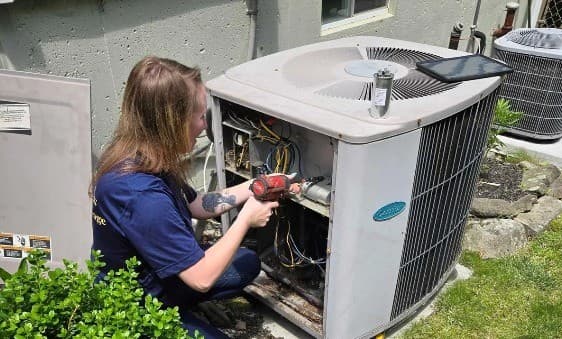
A comprehensive spring air conditioning maintenance visit typically covers several critical system components. Technicians inspect and clean evaporator and condenser coils, check refrigerant charge and pressure, test electrical connections and capacitors, clear condensate drain lines and verify thermostat calibration. They also examine the blower motor, lubricate moving parts and measure airflow across the evaporator coil to confirm the system is distributing cooled air as designed.
Filter replacement is among the most impactful steps homeowners can take between professional visits. The Department of Energy recommends replacing or cleaning air conditioner filters every one to two months during the cooling season, especially in homes with pets, high dust levels or heavy use. A clean filter improves airflow, protects internal components from dirt accumulation and helps the system operate more efficiently.
Condensate drain maintenance is another frequently overlooked step. The Department of Energy advises clearing drain channels periodically with a stiff wire to prevent clogs, which can cause the system to shut down or lead to water damage if left unaddressed.
National data suggests that more homeowners are connecting system maintenance with their energy costs. A January 2026 survey conducted by Carrier found that 55 percent of U.S. homeowners plan to upgrade or remodel their homes this year, with heating and cooling systems ranking among the top 10 planned improvement projects. The same survey found that one in four homeowners considering HVAC replacement cited high energy bills caused by system inefficiency as their primary motivation.
The survey also revealed a knowledge gap: while 68 percent of homeowners are aware that a new HVAC system can reduce energy costs, just under half know about available financial incentives such as rebates and tax credits. More than a quarter of homeowners reported not knowing the age of their current system—a factor that can delay proactive maintenance and lead to higher costs over time.
“Homeowners are paying closer attention to how much their cooling systems actually cost to run,” said the Royal Class Service spokesperson. “A well-maintained system doesn’t just prevent breakdowns. It keeps monthly energy bills from creeping up all summer long.”
Beyond scheduling a professional AC maintenance visit, homeowners can take several steps to prepare their cooling systems for summer. Clearing at least two feet of vegetation and debris from around the outdoor condenser unit ensures adequate airflow for heat release. Checking that all indoor supply and return vents are open and unobstructed helps the system distribute cooled air evenly throughout the home.
Testing the thermostat in cooling mode before sustained use confirms the system responds correctly. Homeowners should switch the setting to cool, set a temperature below the current room temperature and listen for the system to engage within a few minutes.
For Hudson Valley residents, spring maintenance carries additional relevance. Winter freeze-thaw cycles can shift outdoor equipment on its mounting pad, and the region’s heavy spring pollen season means filters may need more frequent replacement than in other parts of the state. Homeowners in older homes—common across Orange, Dutchess, Ulster and Putnam Counties—should also verify that ductwork connections remain sealed, as aging ducts can develop leaks that allow cooled air to escape into unconditioned spaces.
