

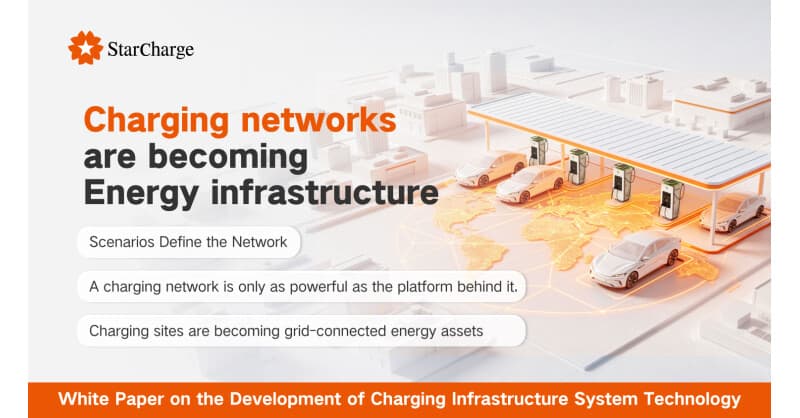
StarCharge, a global leader in EV charging equipment and smart energy systems, has released two industry white papers during a major seminar in Hong Kong, highlighting transformative trends in the electric vehicle (EV) charging and microgrid sectors. The papers, titled 'Technical White Paper' and 'Scenario-based Microgrid Technology White Paper,' explore how charging infrastructure is evolving into a key component of smart energy systems and how microgrids are moving from customization to scaling up development.
According to the 'Technical White Paper,' EV charging infrastructure has traditionally been viewed as support for vehicle sales expansion, focusing on building more chargers and expanding coverage. However, as electrification scales, charging networks are becoming integrated into the energy system itself. They are transforming into smart energy nodes that connect vehicles, the grid, distributed energy, storage, and digital management. This shift from charging infrastructure to charging network systems indicates a move from basic access to integrated value, encompassing charging services to energy services, standalone stations to PV-storage-charging systems, and equipment deployment to scenario-based infrastructure.
The white paper identifies four key turning points reshaping the ecosystem. First, charging networks are becoming strategic energy infrastructure, connecting mobility demand with the grid, distributed energy, storage, digital platforms, and future energy services. Second, defining scenarios for the network is crucial, as different use cases—such as urban commuting, highway trips, logistics fleets, and autonomous driving—require tailored charging solutions rather than a one-size-fits-all approach. Third, digital platforms are essential for turning charging networks into operable assets, enabling site selection, pricing, station operations, smart maintenance, AI-based charging, and ESG reporting. Fourth, charging stations are evolving into grid-friendly energy resources through high-power charging, liquid cooling, integrated PV-storage-charging, V2G, and AI-driven operations, allowing them to absorb renewable energy, buffer peak loads, and provide grid services beyond charging fees.
Simultaneously, the 'Scenario-based Microgrid Technology White Paper' emphasizes that microgrids are moving from customized engineering projects toward scalable, replicable energy systems. A microgrid is defined as a local energy system designed around specific scenarios, coordinating local generation, loads, storage, control, and operational strategies. The white paper highlights four high-value paths: electricity-computing synergy, independent power supply, zero-carbon parks, and green mines. In areas with weak grids, microgrids ensure critical load operation, while in data centers and industrial parks, they support renewable energy integration and cost optimization.
The white paper outlines a three-stage evolution of microgrids: Microgrid 1.0, dominated by AC architecture; Microgrid 2.0, an AC-DC hybrid stage expected to remain mainstream for 10-15 years; and Microgrid 3.0, the era of DC microgrids that reduce conversion losses and support millisecond-level responses. This evolution is linked to breaking energy access bottlenecks and unlocking integrated value of local energy systems.
StarCharge's insights come as the global EV charging market enters a new stage of rapid expansion, with continued strong expectations for new energy vehicle exports. The company plans to leverage its smart energy systems, validated in the Chinese market, to expand into growing global markets for EVs and renewable energy.
