

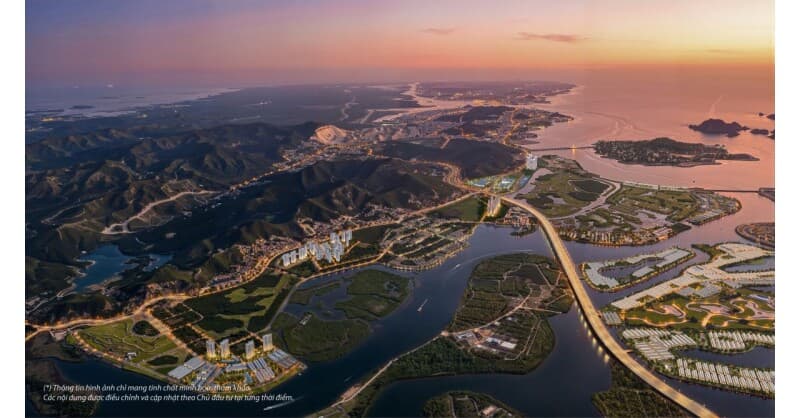
Vinhomes has released the master plan for Vinhomes Global Gate Ha Long, an integrated urban development spanning approximately 6,200 hectares adjacent to the UNESCO-listed Ha Long Bay in Vietnam. This project, the company's largest to date, represents a shift in urban development metrics: success is no longer measured by land size but by the value each hectare delivers to residents and the environment.
For decades, the scale of master-planned communities has been a key indicator of ambition, with developments over 2,500 acres considered large. However, according to the OECD, future cities must do more than expand; they must connect people to jobs and services, enhance climate resilience, and integrate nature into urban infrastructure. Vinhomes Global Gate Ha Long is designed to meet these criteria, positioned along the Hanoi–Hai Phong–Quang Ninh Expressway at the crossroads of northern Vietnam's tourism, industrial, and logistics corridors.
The project is planned as a fully integrated city, not merely a residential complex. It aims to shorten distances between living, working, learning, and accessing services. A key feature is its location near the future depot station of the Hanoi–Quang Ninh high-speed railway, which is expected to connect residents to Hanoi in about 23 minutes, enabling daily commutes between the capital and the World Heritage landscape.
Residents will have uninterrupted views of Ha Long Bay and benefit from clean air and expansive waterfronts. Residential options include villas, townhouses, shophouses, and high-rise apartments across six districts. The development dedicates over 2,500 hectares to green spaces, water bodies, and mangroves, including 680 hectares of naturally filtered seawater, approximately 200 kilometers of coastline, and the 660-hectare Globe Ha Long Forest Park. These ecological assets are designed to support biodiversity, climate resilience, and healthier living, aligning with Vinhomes' ESG++ vision for regenerative development.
The city is organized around interconnected ecosystems. Culture and entertainment venues include a 60,000-seat outdoor waterfront venue, the 3,000-seat Wonder Theatre, an 81-hectare VinWonders destination with plans for the world's largest aquarium park, an international convention center for over 4,500 guests, and an 18.5-hectare Vietnamese Cultural and Culinary Village. Hospitality offerings feature luxury hotels, integrated casino facilities, a 950-hectare golf complex with 12 courses, an 800-hectare mangrove recreational park, and Wonder Marina with direct access to Ha Long Bay.
Commerce and lifestyle amenities center on Vincom Mega Mall, premium outlets, Vincom Collection retail streets, and lifestyle destinations, creating a 24-hour retail and dining environment. Sports and wellness facilities include Vietnam's first purpose-built Sports District spanning 13.3 hectares, a professional sports academy, and over 50 kilometers of cycling routes. Health and education are served by the 14-hectare Vinmec Cleveland Clinic International Hospital, Vin New Horizon, the country's largest senior living center, Golden Residence retirement villas, Vinschool campuses, an American international school, and Wonder Young Hub for youth development.
Anchoring economic growth is a new central business district with office towers of 30 to 45 stories, designed to attract businesses and reinforce Ha Long's role as a major economic hub. The project aligns with ISO 37125, the international standard for sustainable urban development, and incorporates Vingroup's ESG++ approach, which extends beyond environmental protection to include ecological regeneration, resource efficiency, digital governance, resilient infrastructure, and community wellbeing.
Smart technologies, including AI, IoT, and data-driven management, are planned to optimize operations, alongside green mobility and efficient public infrastructure. Guided by principles of connectivity, regeneration, and excellence, Vinhomes Global Gate Ha Long aims to demonstrate how mobility, environmental stewardship, public services, commerce, and culture can function within a single framework, setting a new standard for future urban development.
