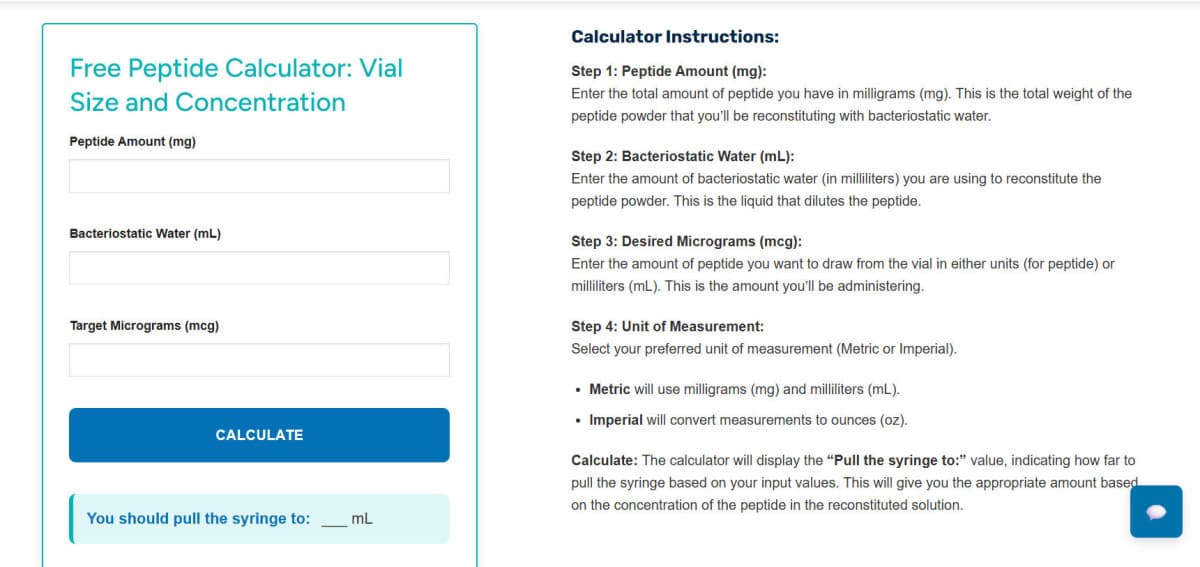
Precise calculation and reconstitution of peptide vials are critical for ensuring reproducibility in research workflows, according to a comprehensive technical guide. The methodology outlined addresses the complete process from determining concentration of stock solutions and executing unit conversions to reconstituting peptides in sterile environments and preparing working dilutions.
Peptide concentration calculation follows the fundamental formula where concentration (mg/mL) equals peptide mass (mg) divided by diluent volume (mL). This can be converted to micrograms per milliliter by multiplying mg/mL by 1000. For researchers requiring molarity calculations, the formula involves dividing mg/mL by molecular weight (g/mol) and multiplying by 1000. Understanding unit conversions proves essential, with 1 mg equaling 1000 mcg, and for U-100 insulin syringes, 1 mL equaling 100 IU, enabling accurate conversion of target microgram amounts into precise draw volumes.
In practical application, if a stock solution has a concentration of 5 mg/mL, it equates to 5000 mcg/mL. To find the volume required for 250 mcg, researchers calculate volume (mL) as 250 mcg divided by 5000 mcg/mL, resulting in 0.05 mL. This mathematical precision ensures consistent preparation of stock solutions and reliable experimental measurements.
The reconstitution process involves dissolving lyophilized peptides in appropriate diluents while maintaining sterile conditions. Diluent selection varies based on peptide characteristics and intended use. Bacteriostatic water includes preservatives suitable for multi-use vials, while sterile water serves as an inert option ideal for single-use aliquots. DMSO effectively dissolves hydrophobic peptides but requires immediate dilution into aqueous buffers, and low percent acid enhances solubility of charged peptides.
The step-by-step reconstitution protocol begins with establishing a clean workspace and gathering necessary equipment including syringes, diluent, labels, and personal protective equipment. After disinfecting the vial septum with an alcohol swab, researchers draw the calculated volume of diluent into a sterile syringe and inject slowly along the vial wall to minimize foaming. Gentle swirling or flicking of the vial continues until complete dissolution occurs, avoiding vigorous vortexing that could cause aggregation. If dissolution remains incomplete, researchers may allow for equilibration, use brief sonication, or add minimal amounts of co-solvent. Proper labeling includes concentration, solvent, date, and any modifications made, with aliquoting following cold-chain guidelines when necessary.
Storage protocols differentiate between lyophilized and reconstituted peptides. Lyophilized peptides require cold, dry environments, typically at -20°C for short-term and -80°C for long-term storage, protected from light and moisture. Reconstituted peptides can be refrigerated for short-term use or frozen at -20°C or -80°C for prolonged periods, with limitations on freeze-thaw cycles and clear labeling of all aliquots.
Troubleshooting solubility and aggregation challenges involves multiple approaches. Initial strategies include gentle swirling and flicking followed by equilibration time. For persistent issues, brief sonication or cautious addition of small amounts of DMSO or low percent acid may prove effective. Immediate dilution into aqueous buffers after dissolution helps maintain stability. If aggregation continues despite these measures, preparing a new vial and reassessing storage conditions becomes necessary.
Preventive strategies emphasize proper solvent selection, slow addition to buffers, maintaining suitable pH and ionic strength, aliquoting to minimize freeze-thaw cycles, and avoiding repeated exposure to room temperature. Documentation of every step, including solvents and adjustments, enhances reproducibility across experiments. Additional resources and technical support are available through https://lotilabs.com.