

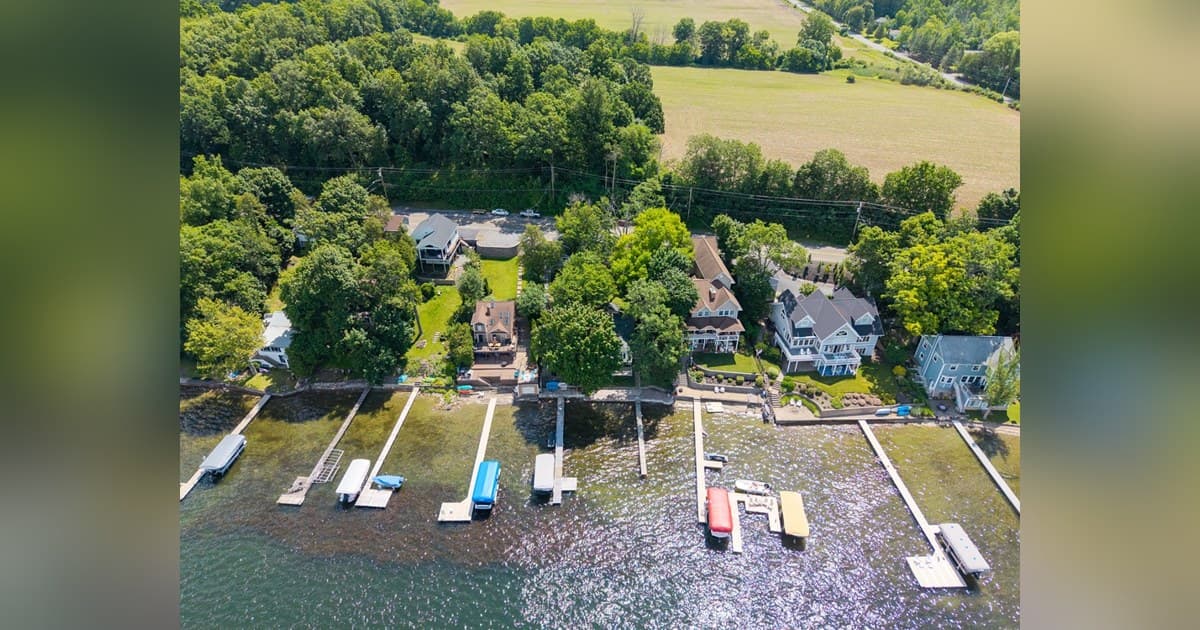
For waterfront property owners on Conesus Lake in Livingston County, New York, the transition from summer to winter is not just a matter of changing calendars. It is a race against the weather, one that carries financial and practical consequences for those who misjudge the timeline. Unlike inland homeowners, lakefront owners must remove docks, winterize boats, and store equipment before the first hard freeze. The window for these tasks typically runs through September and October, though New York State Parks lists the docks at the Conesus Lake Boat Launch as available from late April through October 15—a useful marker for the season's general timing, but not a rule for private owners.
Matthew Sharman, team leader of The Sharman Team at Real Broker NY LLC, who specializes in the Conesus Lake waterfront market, warns that waiting for a specific date is a mistake. "Winter comes unannounced often, and it stays," he says. An unseasonably warm weekend in late September can lull owners into delaying, but Sharman advises working backwards from when the boat is realistically done for the year, then coordinating equipment and booking removal against that date. By October, scheduling becomes tight as dock removal companies compress most of their work into a few weeks. "You're not trying to win a contest for the last dock in the lake," Sharman says.
Most owners hire out dock removal, but for those handling it themselves, Sharman recommends documenting the process before disassembly. Photographing the system in place, labeling sections, and even recording video can prevent reassembly headaches. "Future me will remember where this goes—that's not a system," he notes. Removal also offers a rare chance to inspect and clean the underside of the dock, and hardware should be consolidated for storage. Storage itself is an often-overlooked factor: some properties have space to stack sections, while others must transport the dock off-site, adding an annual cost. Sharman suggests establishing storage logistics during a purchase rather than discovering the need the following autumn.
Material choice affects long-term workload. Permanent installations are uncommon on Conesus, Honeoye, and Silver Lake, where most systems come out seasonally. Aluminum has become the prevailing choice, costing more upfront but requiring less maintenance than wood, which needs paint, staining, and periodic board replacement. Sharman describes the tradeoff as "buy once, cry once." Beyond the dock, engines and onboard systems need fuel treatment, fluid checks, and battery attention. Lifts and canopies require their own care, and items like ladders, furniture, kayaks, and hoses must be addressed. Electrical and water winterization are areas where Sharman suggests hiring a contractor if there is any doubt, as failures can be expensive and hidden until spring. He also recommends a written checklist with a named responsible party for each task.
Repairs done in late autumn rather than deferred mean an owner is ready for spring instead of joining a queue. Sharman frames dock maintenance as protecting value and reducing uncertainty, not as a dollar-for-dollar return. However, a deteriorated dock on an otherwise well-kept property can disproportionately affect how the entire property is perceived. "The dock is your gateway to what everyone's paying for, which is the lake," he says. This is one input in his Property Value Review (PVR™), a valuation process that considers condition, competing inventory, buyer behavior, and property-specific features. For anyone buying into a waterfront property this autumn, Sharman's practical point is that the handoff should happen before it is needed: who installs and removes the dock, where everything is stored, which service has been used, whether spring installation is a separate appointment, and which equipment actually conveys. Docks usually transfer with the property; hoists frequently do not. An assumption not written into the contract is an assumption that costs money.
