

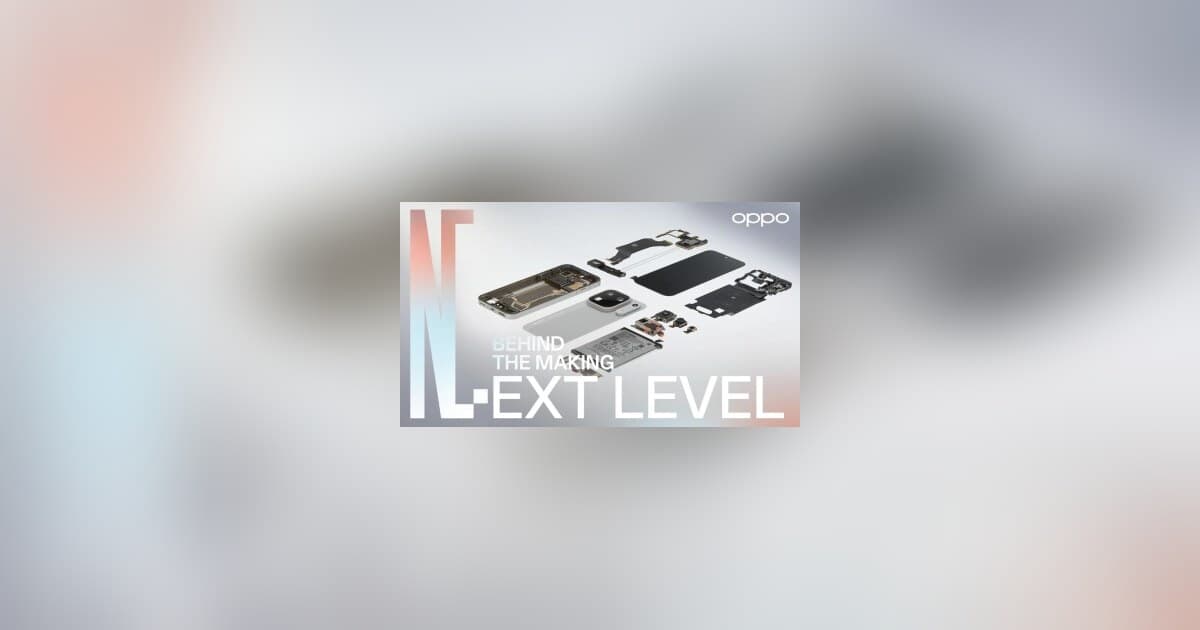
OPPO has provided an in-depth look at the development and manufacturing processes behind its latest flagship, the Find X10 Series, through a media tour titled 'Next Level of Making.' The event, announced via Media OutReach Newswire, follows the series' global debut and underscores OPPO's integrated approach to product design, mobile imaging, and artificial intelligence. The tour detailed how each technology and feature is developed, tested, and verified through rigorous processes to deliver exceptional quality and consistency on a global scale.
"Quality is the foundation of OPPO's entire product portfolio, and our control over the product creation process is what allows us to realize this commitment at scale," said Ling Liu, Overseas CMO of OPPO. "Last year, we introduced Apex Guard to show how our commitment to quality goes beyond everyday use, product lifespans, and industry standards. This year, we are opening up our development, testing, and manufacturing processes to unveil how that vision translates into the Next Level of Making, and ultimately elevates the products and experiences we deliver."
The design of the Find X10 Series exemplifies OPPO's 'Clean and Sophisticated' language, featuring a One-Piece Sculpted Glass design that softly integrates the camera module into the body. The Luna White edition of the Find X10 Pro Max introduces a fluted texture reminiscent of classic camera focus rings, achieved through high-precision CNC engraving, and a two-tone woven pattern within the matte glass. These details result from extensive refinement: the Luna White colorway alone underwent over 40 rounds of fine-tuning, and each rear-panel pattern requires more than 10 rounds of multi-stage precision treatments to ensure both appearance and durability.
The camera system, co-developed with Hasselblad since 2022, includes three Hasselblad modes—Master Mode, Hi-Res Mode, and Portrait Mode—and is powered by the next-generation LUMO True Image Engine. This engine comprises the LUMO Natural Tone Engine, the LUMO True Color Engine (utilizing a 24-channel multispectral sensor), and the LUMO Hyper Pixel Engine, which enables continuous 26MP output by default and full-resolution 200MP photos in Hi-Res Mode. OPPO's testing regime for image quality is rigorous, assessing HDR performance, facial brightness, and skin-tone gradation across 40 lighting conditions, and testing color reproduction against 140 different colors—far beyond the industry-standard 24-color chart. Real-world scenarios, including concert simulations and robotic-arm stabilization tests, complement laboratory metrics to ensure lifelike results.
On the AI front, ColorOS 17 introduces system-level AI supported by a dedicated security framework. The AI Mind Pilot now includes an Agent Mode powered by third-party AI agent Manus, which operates on-device to understand complex context and execute multi-step workflows in real time. A new AI Photo Agent, backed by OPPO's proprietary Visual-Language Model and six expert image models, interprets visual references and natural-language instructions to make desired edits. This AI performance is underpinned by OPPO's global computing infrastructure: nine Internet Data Centers across six regions, each deployed to meet local regulatory requirements and achieve 99.99% availability. OPPO's AI Security Framework and Private Computing Cloud, developed with Google, safeguard user data throughout the AI lifecycle.
Manufacturing scale is equally critical. Since introducing automated manufacturing in 2017, OPPO now operates nine smart manufacturing centers globally, located in China, India, Indonesia, Egypt, Turkey, Brazil, Pakistan, and Bangladesh. These facilities boast over 95% automation in Surface Mount Technology lines and an average of 85% automation in final assembly. The Chang'an Intelligent Manufacturing Center in China uses over 300 automated testing stations to accelerate innovation-to-production timelines and ships up to 7,200 finished Find X10 Pro Max devices daily. Continuous improvements in processes such as display assembly, camera module installation, airtightness testing, and battery compartment inspection further enhance precision and consistency.
This announcement matters because it offers transparency into how OPPO achieves quality at scale, potentially strengthening consumer trust and setting benchmarks for the smartphone industry in design, imaging, AI, and manufacturing. For readers, it signals that the Find X10 Series is backed by verifiable processes and infrastructure, which may influence purchasing decisions and expectations for future devices.
